
10 Best Industrial Floor Scrubber Machines for Businesses

Busy warehouses, retail stores, hospitals, and workshops need floors that stay safe and presentable every day. Dust, oil, tracked-in grit, and spilled liquids can quickly damage surfaces or create slip risks. An Industrial Floor Scrubber helps remove these problems more efficiently than traditional mopping, especially across large, high-traffic areas.

This guide reviews 10 best industrial floor scrubber machines for businesses. The selection considers cleaning width, tank capacity, battery performance, maneuverability, drying results, operator comfort, and maintenance needs. Real working conditions matter. A compact walk-behind model may suit a narrow restaurant aisle, while a ride-on machine can save time in a distribution center.

Details matter.

Reliable equipment should leave the floor clean and nearly dry, not covered in cloudy water. Strong brush pressure can lift embedded dirt, but excessive pressure may wear delicate flooring. Battery runtime also deserves careful attention. A machine that stops halfway through a shift can disrupt cleaning schedules and increase labor costs.

The recommendations draw on practical cleaning considerations, manufacturer specifications, and common commercial use cases. Still, no single machine is perfect for every business. Some models may perform well on concrete but feel awkward in tight spaces. Others may offer impressive power while requiring more frequent maintenance. That trade-off is easy to overlook.

Before choosing, measure the cleaning area, inspect the floor type, and estimate daily usage. Consider noise levels, service access, replacement parts, and training requirements. A lower purchase price may not mean lower ownership costs. The right choice should support consistent results, safer operations, and realistic long-term budgets.
10 Best Industrial Floor Scrubber Machines for Businesses

Industrial Floor Scrubbers: Purpose, Types, and Core Functions

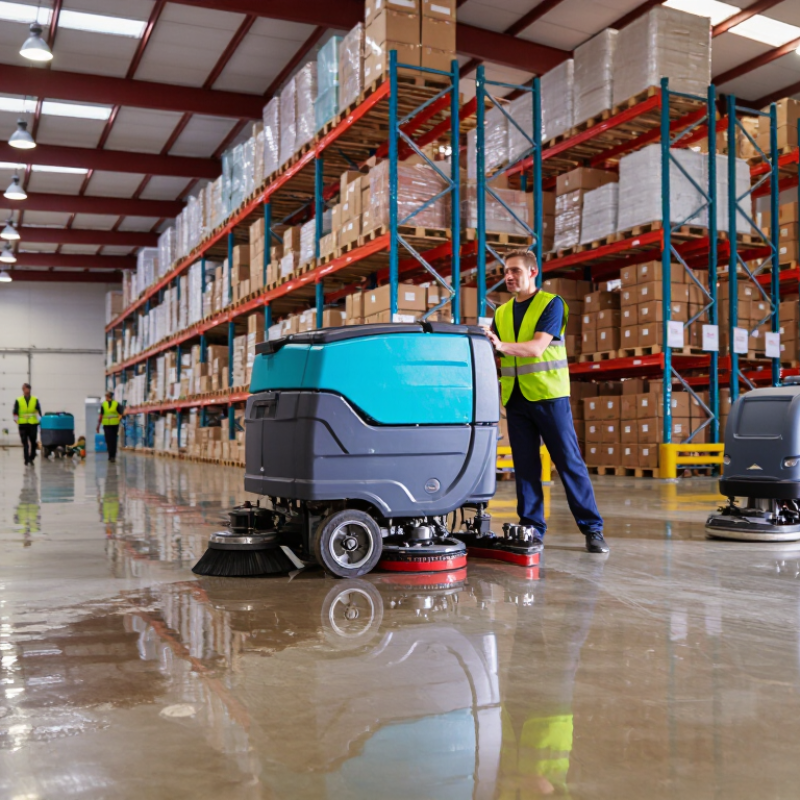
Industrial floor scrubbers remove soil through controlled water, chemical, agitation, and vacuum recovery. They are built for warehouses, factories, hospitals, retail floors, and transport facilities. A single pass can leave a wide concrete aisle visibly cleaner, with less standing water underfoot.

The main types include walk-behind, ride-on, cylindrical, orbital, and robotic scrubbers.

Walk-behind units suit narrow aisles and changing layouts. Ride-on machines cover large surfaces faster.

Cylindrical systems can collect light debris while scrubbing, whereas orbital machines reduce water use on some resilient floors.

Robotic models support routine cleaning, but they still need human checks around pallets, corners, and spills. They are not magic.

Core functions include solution control, brush-pressure adjustment, soil recovery, battery monitoring, and automatic squeegee lifting.

These controls affect cleaning quality more than machine size alone.

Fortune Business Insights estimated the global floor scrubber market at about USD 3.47 billion in 2023, with continued growth through 2030. Grand View Research also identifies automation and demand for efficient commercial cleaning as major market drivers.

Such figures indicate adoption, not guaranteed productivity. Actual results depend on floor texture, operator training, maintenance, and traffic patterns.

In practice, an undersized machine may require extra passes,

while an oversized unit can miss tight edges.

That trade-off is easy to underestimate.

Key Criteria for Evaluating Commercial Floor Scrubber Machines

Choosing among the 10 best industrial floor scrubber machines requires more than comparing brush speed and tank size. Evaluate measurable performance first. Check cleaning width, water recovery, noise, battery runtime, turning radius, and drying time. A machine that leaves a wet aisle creates operational risk. It may also slow warehouse traffic.

Labor efficiency deserves serious attention. The U.S. Bureau of Labor Statistics projects employment for janitors and building cleaners to grow from 2023 to 2033, increasing pressure on facility teams. Faster cleaning is useful, but only when operators can control the machine easily. Test the scrubber on textured concrete, narrow corridors, ramps, and heavily soiled loading areas. Record square meters cleaned per hour, water consumed, charging time, and recovery performance. Manufacturer claims are helpful. Real floors are less forgiving.

Tips:

Request a supervised site trial before purchasing. Measure noise beside offices and occupied workspaces. Inspect squeegees, filters, brushes, and battery access without tools. The U.S. Energy Information Administration’s Commercial Buildings Energy Consumption Survey reports millions of commercial buildings across the country, showing why total operating cost matters beyond purchase price. Include electricity, water, detergent, maintenance, training, and downtime in your comparison. A cheaper machine can become expensive when parts are difficult to source. I would also question perfect-looking test results; they may not reflect uneven floors, winter grit, or rushed shifts. Reliable evaluation needs repeated trials, clear records, and operator feedback.

Ten Leading Industrial Floor Scrubber Machines for Business Use

Ten Leading Industrial Floor Scrubber Machines for Business Use

The ten leading industrial floor scrubber machines serve different commercial cleaning conditions. Compact walk-behind models suit narrow aisles and small retail spaces. Ride-on scrubbers cover warehouses, terminals, and manufacturing floors faster. Cylindrical brushes handle textured surfaces and collect light debris during cleaning. Orbital machines reduce chemical use on sensitive flooring. Battery-powered units improve movement around busy facilities. Corded machines can offer steady power in smaller zones. Robotic scrubbers support scheduled cleaning during low-traffic periods. High-capacity recovery tanks reduce dumping interruptions. Adjustable brush pressure protects polished concrete and coated floors. Quiet machines work better in hospitals, hotels, and occupied offices.

Grand View Research projects the floor-cleaning machines market to grow at about 8.7% annually from 2024 to 2030. That growth reflects stronger demand for labor efficiency and measurable cleaning results. Yet productivity should not replace practical testing. A large ride-on unit may struggle beside shelving or loading bays. I have seen specifications look impressive while recovery performance fell on uneven concrete. Small details matter. Check turning radius, drying time, tank capacity, and battery charging requirements before purchase.

Safety also deserves measurable attention. The U.S. Bureau of Labor Statistics recorded 885 fatal work injuries involving falls, slips, and trips in 2023. A scrubber should leave floors visibly clean and safely dry. Operators need clear training, proper warning signs, and routine maintenance records. The best machine is not always the largest. It is the one that matches floor texture, traffic patterns, labor availability, and cleaning schedules. Mistakes still happen, especially during rushed shifts. Conservative selection often prevents expensive rework.

10 Best Industrial Floor Scrubber Machines for Businesses

Comparison of ten industrial floor scrubber configurations using cleaning width, travel speed, and theoretical cleaning productivity. The productivity estimate is calculated as cleaning width × travel speed and represents maximum theoretical coverage before adjustments for turning, refilling, obstacles, and operator movement.

Values are shown in metric units. Actual productivity will vary according to floor layout, soil level, water management, and operating conditions.

Best Applications for Different Business Environments

Choosing among the 10 best industrial floor scrubber machines starts with the business environment, not the machine’s advertised power. A compact walk-behind scrubber suits cafés, clinics, and narrow retail aisles. It can turn quickly around tables and reach corners where larger equipment cannot. For warehouses, logistics centers, and manufacturing plants, a ride-on scrubber covers wide concrete floors faster. Battery capacity matters when cleaning continues through a long shift.

Busy supermarkets need machines with low noise, quick drying, and strong edge cleaning. Wet floors near customers create avoidable safety concerns. In hospitals and laboratories, operators should prioritize controlled water flow, easy-to-disinfect surfaces, and precise handling. Food-processing areas may require corrosion-resistant components and cleaning procedures that match site hygiene requirements. Always verify the machine’s materials and maintenance guidance before purchase.

Parking structures and loading bays often need stronger traction and larger recovery tanks. Outdoor dust can also clog filters faster than expected. No machine is perfect. A ride-on model may save labor but struggle in tight storage rooms. A smaller scrubber may clean slowly across a large plant. In my experience, trialing the machine on real flooring reveals more than a showroom demonstration. Test turning space, drying time, battery endurance, and operator comfort during a normal workday. A simple inspection log can expose recurring problems before they become expensive repairs.

10 Best Industrial Floor Scrubber Machines for Businesses - Best Applications for Different Business Environments

The specifications below represent typical operating ranges for commercial and industrial floor scrubbers. Actual performance depends on floor condition, brush pressure, operator technique, detergent use, and site layout.
No. Machine Type Best Business Environment Recommended Floor Surfaces Cleaning Width Typical Productivity Solution Tank Recovery Tank Typical Runtime Key Advantages
1 Compact Walk-Behind Disc Scrubber Small retail stores, cafés, clinics, offices, and narrow commercial corridors Sealed concrete, ceramic tile, vinyl, terrazzo, and epoxy-coated floors 17–20 in / 43–51 cm 12,000–18,000 sq ft/h
1,115–1,670 m²/h
3–6 gal
11–23 L
4–7 gal
15–26 L
1.5–3 h per charge Compact turning radius, easy transport, low water consumption, and good visibility around fixtures.
2 Heavy-Duty Walk-Behind Disc Scrubber Supermarkets, schools, warehouses, workshops, and medium-sized production areas Concrete, quarry tile, textured porcelain, terrazzo, and industrial resin floors 24–32 in / 61–81 cm 20,000–35,000 sq ft/h
1,860–3,250 m²/h
10–20 gal
38–76 L
12–22 gal
45–83 L
2–4 h per charge Higher brush pressure, longer operating cycles, strong recovery performance, and suitability for routine deep cleaning.
3 Compact Ride-On Scrubber Shopping centers, parking structures, logistics facilities, and large retail floors Concrete, polished concrete, epoxy, vinyl composition tile, and ceramic tile 24–34 in / 61–86 cm 30,000–50,000 sq ft/h
2,790–4,645 m²/h
12–20 gal
45–76 L
14–24 gal
53–91 L
2.5–5 h per charge Reduces operator fatigue, improves productivity on open floors, and provides a comfortable driving position.
4 Large Ride-On Scrubber Airports, distribution centers, manufacturing plants, arenas, and high-traffic facilities Large concrete slabs, epoxy floors, terrazzo, and industrial tile 36–48 in / 91–122 cm 50,000–85,000 sq ft/h
4,645–7,900 m²/h
25–40 gal
95–151 L
28–45 gal
106–170 L
3–6 h per charge High coverage per pass, large tank capacity, productive for extensive unobstructed areas, and reduced refill frequency.
5 Battery-Powered Cylindrical Scrubber Food-processing plants, grocery aisles, warehouses, and facilities with debris or grout lines Textured concrete, safety flooring, quarry tile, grooved surfaces, and uneven hard floors 20–32 in / 51–81 cm 18,000–38,000 sq ft/h
1,670–3,530 m²/h
8–20 gal
30–76 L
9–22 gal
34–83 L
2–5 h per charge Cylindrical brushes can collect light debris while scrubbing and reach grooves more effectively than standard disc brushes.
6 Orbital Floor Scrubber Schools, hospitals, offices, retail facilities, and buildings requiring low-chemical cleaning Vinyl, linoleum, terrazzo, sealed concrete, stone, and resilient flooring 14–28 in / 36–71 cm 10,000–25,000 sq ft/h
930–2,325 m²/h
2–8 gal
8–30 L
2–10 gal
8–38 L
1.5–4 h per charge Uses rapid multidirectional motion, often requires less water and detergent, and can support chemical-free floor maintenance.
7 Low-Profile Scrubber-Dryer Restaurants, hospitals, airports, hotels, and areas beneath shelving or fixed equipment Tile, vinyl, resin, sealed concrete, terrazzo, and smooth stone 18–28 in / 46–71 cm 14,000–30,000 sq ft/h
1,300–2,790 m²/h
5–12 gal
19–45 L
6–14 gal
23–53 L
2–4 h per charge Low overall height, strong maneuverability, and rapid drying for spaces that must reopen quickly.
8 Walk-Behind Rotary Scrubber Workshops, service garages, industrial maintenance rooms, and heavily soiled floors Concrete, quarry tile, stone, epoxy, and other durable hard surfaces 17–24 in / 43–61 cm 8,000–18,000 sq ft/h
745–1,670 m²/h
3–10 gal
11–38 L
4–12 gal
15–45 L
1.5–3 h per charge High mechanical agitation helps remove oil residue, embedded soil, and stubborn deposits from durable flooring.
9 Quiet Compact Scrubber-Dryer Hospitals, nursing homes, libraries, hotels, and occupied office buildings Vinyl, linoleum, ceramic tile, terrazzo, and sealed stone 16–22 in / 41–56 cm 10,000–22,000 sq ft/h
930–2,045 m²/h
4–8 gal
15–30 L
5–10 gal
19–38 L
2–4 h per charge Lower operating noise, compact dimensions, and fast water pickup make it appropriate for cleaning during business hours.
10 Ride-On Sweeper-Scrubber Combination Manufacturing plants, distribution centers, wholesale stores, and dusty industrial facilities Concrete, textured concrete, epoxy, warehouse tile, and hard resin flooring 32–52 in / 81–132 cm 45,000–90,000 sq ft/h
4,180–8,360 m²/h
20–40 gal
76–151 L
22–45 gal
83–170 L
3–6 h per charge Combines loose-debris collection with wet scrubbing, reducing the need for separate sweeping and washing passes.

Productivity figures are theoretical or typical working ranges and may be lower in congested areas, during heavy soil removal, or when frequent stops and turns are required.

Maintenance, Safety, and Operating Cost Considerations

Choosing among the 10 best industrial floor scrubber machines requires more than comparing brush width and tank capacity. In busy warehouses, maintenance determines whether a machine earns its place. Check squeegee blades, recovery hoses, filters, and brush decks after every shift. Rinse dirty-water tanks before residue hardens. Small deposits can reduce suction and leave gray trails across polished concrete. Keep a dated service log. It reveals repeated failures better than memory.

Safety begins with the operator, not the machine. Train staff to slow down near loading bays, blind corners, and wet transitions. Use warning signs while floors dry. Inspect cables, batteries, wheels, and emergency controls before operation. Battery charging areas need ventilation and clear access. Never ignore unusual vibration or a burning smell. Stop and inspect. Rushed training remains a practical weakness. A five-minute demonstration may not cover crowded aisles or chemical handling. Review procedures after near misses.

Operating cost includes water, detergent, electricity, labor, and downtime. A larger tank may reduce refills, yet it can increase maneuvering time in narrow spaces. Measure cleaning minutes per 1,000 square meters before choosing capacity. Use the approved dilution, because excess detergent creates foam and raises rinsing costs. Track battery runtime across real shifts, not showroom estimates. I have found that inexpensive parts can become costly when replaced too often. Budget for filters, blades, brushes, inspections, and operator training. That estimate may still be wrong; seasonal dirt and uneven floors can change it.

Back To Top