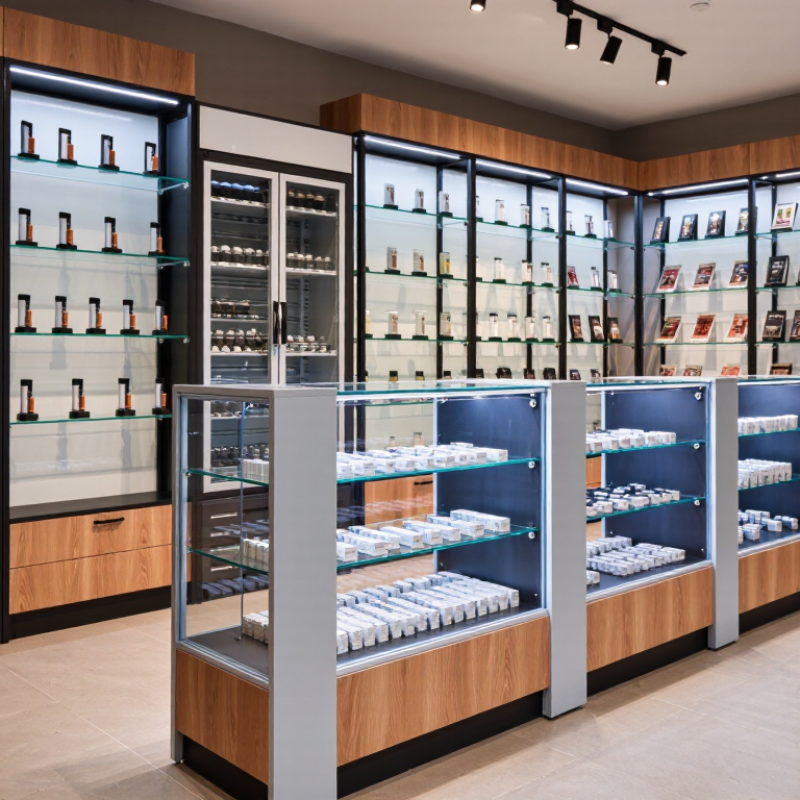
| Load Capacity | At least 40–75 lb per adjustable shelf, depending on shelf width and depth | Prevents sagging or failure when displaying glassware, boxed products, accessories, and packaged inventory. | Check the manufacturer’s evenly distributed load rating and confirm that it matches the intended merchandise. |
| Shelf Adjustability | Shelf spacing increments of approximately 1–1.5 inches with tool-free or low-tool adjustment | Allows the layout to accommodate products with different package heights and seasonal displays. | Move several shelves and verify that brackets lock securely without excessive looseness. |
| Material and Frame Strength | Powder-coated steel for high-use areas; reinforced wood or laminate panels for coordinated interiors | A rigid frame improves stability, service life, and resistance to dents, chips, and everyday impact. | Inspect welds, joints, uprights, panel edges, and the finish for visible flexing or damage. |
| Shelf Depth | Common retail depth: approximately 10–16 inches, selected according to product size and aisle width | Balances product visibility and storage capacity while helping maintain comfortable customer circulation. | Measure the usable depth, then compare it with the largest products and the planned aisle clearance. |
| Unit Height and Reach | Use lower and mid-height fixtures for open shopping; reserve taller units for supervised or wall displays | Appropriate height improves visibility, replenishment efficiency, and staff oversight. | Check whether staff can safely reach the top shelf and whether products remain visible from the aisle. |
| Stability and Anchoring | Leveling feet, a wide stable base, and wall or floor anchoring where required | Reduces tipping risk, especially in narrow aisles, high-traffic areas, or earthquake-prone locations. | Apply light lateral pressure, check for rocking, and follow local building and safety requirements for anchoring. |
| Security Features | Lockable glass doors, secured hooks, anti-sweep lips, or controlled-access compartments where appropriate | Supports loss prevention for small, valuable, regulated, or age-restricted merchandise. | Test locks, hinges, door alignment, hook retention, and staff access during normal operating conditions. |
| Visibility and Lighting | Clear sightlines, minimal visual obstruction, and optional low-heat LED shelf lighting | Improves product recognition and presentation without creating excessive heat or glare. | View the display from several aisle angles and check lighting for shadows, glare, and accessible wiring. |
| Cleaning and Surface Resistance | Smooth, nonporous, wipe-clean surfaces with corrosion-resistant finishes | Frequent cleaning is easier, and the fixture is less likely to retain dust, residue, or odors. | Wipe a sample surface with an approved cleaner and inspect seams, corners, and exposed hardware. |
| Modularity and Expansion | Compatible add-on bays, pegboard or slatwall accessories, and interchangeable shelves | Makes it easier to update merchandising zones without replacing the entire fixture system. | Confirm that extensions, brackets, hooks, dividers, and replacement parts are available. |
| Assembly and Relocation | Clearly labeled components, accessible fasteners, and optional casters only when safely rated | Simplifies store resets, reduces installation downtime, and supports future layout changes. | Review assembly instructions and confirm that moving the unit does not compromise stability or anchoring. |
| Accessibility and Aisle Planning | Maintain locally required accessible routes; in the United States, many retail routes use a 36-inch minimum clear width as a common ADA reference | Good spacing supports safer movement and helps meet applicable accessibility requirements. | Measure the clear route after stocking shelves and verify local codes with a qualified professional. |
| Total Cost of Ownership | Evaluate purchase price, installation, accessories, maintenance, replacement parts, and expected service life | The lowest initial price may cost more if the shelving requires frequent repairs or early replacement. | Compare a three- to five-year cost estimate across the shortlisted shelving configurations. |