
7 Best Automatic Arc Welding Machines to Buy in 2026?

Choosing an Automatic Arc Welding Machine in 2026 means looking beyond advertised speed. Arc stability, duty cycle, wire-feed consistency, and service access all matter on a real shop floor. A smooth demo is useful. It is not proof of long-term reliability.

The International Federation of Robotics reported 4,281,585 industrial robots operating worldwide in 2023, a 10% increase from 2022, in its World Robotics 2024 report. That figure covers many industries and robot types, not welding machines alone. Still, it shows the wider shift toward automated production. The American Welding Society has also projected substantial U.S. demand for welding professionals, including an estimated 330,000 welding-related job openings by 2028. These trends make automation worth evaluating, but they do not make every automated setup suitable for every workshop.

This guide compares seven machines using practical buying criteria: process compatibility, output range, controls, consumable availability, support, and total operating cost. Check whether a machine handles your materials and joint designs before comparing headline amperage. Ask suppliers about parts and local service, too. Downtime is expensive. Specs can look convincing, yet installation needs, operator training, and maintenance may change the real cost. No single model is best for every job, and published data cannot replace a properly supervised test on your own workpieces.
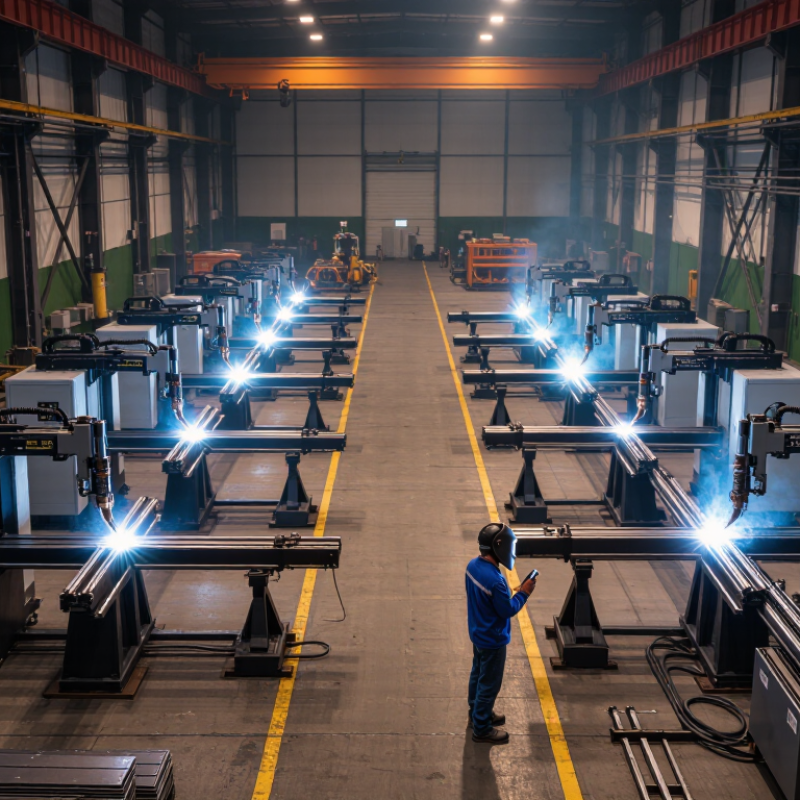
7 Best Automatic Arc Welding Machines to Buy in 2026?

Automatic Arc Welding Defined: Processes Classified by ISO 4063

Automatic arc welding describes how the torch, wire feed, or workpiece is controlled; it is not a separate process number in ISO 4063. The standard identifies welding processes with reference numbers, helping buyers compare equipment and specify procedures clearly. For example, process 121 is submerged arc welding, while 131 is MIG welding with inert gas. Process 135 uses active shielding gas, and 136 uses a flux-cored wire with active gas. Process 141 is TIG welding. Small details matter.

Automation can be applied to several of these processes. A machine may guide a torch along a programmed seam, maintain travel speed, or feed wire continuously. The ISO number identifies the welding process, not how automated the equipment is. That distinction is easy to miss when product descriptions mix process names with control features. For thick, long joints, submerged arc systems can offer consistent deposition under a granular flux blanket. A robotic cell may use a different process and need accurate part positioning, stable gas flow, and repeatable torch angles. Codes help narrow the choice, but they do not predict weld quality by themselves. I would check material, joint geometry, production volume, and required inspection before comparing machines. Real shop conditions are rarely as tidy as a specification sheet.

How Automated GMAW, GTAW, and SAW Systems Work

Automated arc welding systems coordinate the torch, workpiece, wire feed, and travel speed. In GMAW, a motor feeds continuous wire through the torch while shielding gas protects the molten weld pool. Sensors can track seams and adjust the torch path, but poor joint fit-up still causes trouble. GTAW uses a nonconsumable tungsten electrode and, when needed, separately fed filler metal. It offers precise control on thin or heat-sensitive parts, though deposition is slower. More precision. Less speed. In SAW, the arc and wire sit beneath granular flux, making the process well suited to long, steady seams and thick sections.

The process choice shapes the machine. A robot arm can handle varied GMAW paths; a mechanized carriage often suits long SAW joints. GTAW automation needs careful control of torch distance, filler timing, and heat input. Small setup errors matter. The International Federation of Robotics’ World Robotics 2024 report recorded 541,302 industrial robot installations worldwide in 2023, with 4.28 million robots in operation. That figure covers all industrial applications, not welding alone. The American Welding Society’s workforce data projected demand for 320,500 welding professionals by 2029, underscoring why automation is gaining attention. Still, automation does not remove inspection or skilled setup. A bead can look smooth and hide a weak root. Those details are easy to underestimate.

Buying Metrics: Output, Duty Cycle, and IEC 60974-1

Automatic arc welding machines should be judged by usable output, not the largest amperage printed on a panel. Match rated current and voltage to your process, material thickness, and travel speed. A machine reaching 300 amps may still be a poor fit if your daily work needs steady, lower-current operation. Check the adjustment range, too. Small changes matter on thin sheet.

Duty cycle shows how long a power source can weld within a ten-minute period at a stated output and ambient temperature. A 60% rating at 200 amps generally means six minutes of welding and four minutes of cooling under those test conditions. It does not guarantee the same performance in a hot shop, with restricted airflow, or at a higher setting. Read the full rating, not just the percentage. Heat adds up.

For IEC 60974-1, check that the documentation identifies the applicable edition and provides clear ratings, test conditions, and safety information. The standard covers arc-welding power sources, making it a useful verification point when comparing machines. It cannot determine whether a model suits your installation or workflow. Compare equivalent ratings. I would leave some output headroom for demanding shifts, though it may add cost without helping every job. Real production varies.

Seven 2026 Machine Picks by Welding Process and Application

For 2026, match the machine to the joint, material, and production pace—not just its advertised output. Consider a robotic GMAW cell for repeatable steel assemblies; pulse GMAW for thinner sheet; mechanized FCAW for heavy structural welds; submerged arc welding for long, thick plate seams; orbital GTAW for consistent pipe joints; automated GTAW for clean stainless seams; and tandem submerged arc systems for high-deposition work. These are process-based picks, not universal winners. The International Federation of Robotics reported 4,281,585 industrial robots operating worldwide in 2023, up 10% from 2022. That signals wider industrial automation, but it does not guarantee a welding cell will pay off in your shop.

Tips: Test the machine on your actual joint, fixture, and wire or electrode. Check torch access, fume extraction, operator training, and recovery after a failed weld. A glossy cycle-time figure can hide setup delays. Ask for measured results on a representative part, including rework rates and downtime. Slightly inconvenient, but essential.

Before buying, compare duty cycle, control functions, service access, and compatibility with existing fixtures. For short runs, a simpler mechanized system may be more practical than a robot. For high-volume work, repeatability and quick changeovers matter more. Record weld quality and cycle time during trials; one test piece is rarely enough.

Industry Context: IFR Recorded 541,000 Robot Installations in 2023

The International Federation of Robotics (IFR), in World Robotics 2024, recorded 541,302 industrial robot installations worldwide in 2023. It was the second-highest annual total on record. That figure covers many industries and applications, not welding alone. Still, it shows how widely manufacturers are investing in automation.

IFR also reported 162 robots per 10,000 manufacturing employees globally in 2023, up from 151 in 2022. For arc welding, that broader shift matters: automated cells can help maintain repeatable torch paths and steady weld cycles. But installation totals cannot tell a shop which machine suits its parts, material thickness, or production volume.

Look closely at the practical details. A fixture must hold the joint consistently; a small gap can change the weld. Check duty cycle, programming access, seam tracking, and how quickly operators can change jobs. A robot can repeat a poor setup perfectly. That is the uncomfortable part. Automation brings little value if setup time eats into arc-on time, or if staff cannot correct a process drift. IFR’s data signals momentum, not a guarantee of better welds.

Article Source:

Back To Top