7 Best Giant Lanterns for Events and Festivals
Festival lighting must work in the real world, not just in a product photo. At a night market, scale, color, and viewing distance determine whether a lantern becomes a landmark or visual clutter. Choosing giant lanterns should start with the site, audience, and installation plan—not the catalog.
Grand View Research valued the global event management software market at $7.33 billion in 2023 and projected a 12.9% compound annual growth rate from 2024 to 2030. This report tracks event software, not lantern sales, so it cannot prove demand for decorative lighting. It does, however, offer useful context: professional events require careful planning and execution.
This guide compares seven lantern options through practical criteria: frame construction, finish, LED access, power needs, setup time, transport, and storage. Check the maker’s specifications for weather resistance rather than judging it by appearance. Consider how each design reads across an open plaza, then inspect its seams and connectors up close. Bright photos help. They are not proof. Some lanterns look spectacular but take more crew, time, or storage space than expected. That trade-off deserves attention. The best choice depends on the venue, budget, and team handling it. I would be cautious about calling any single design universally “best”; a compact courtyard and a large festival ground ask different things of a lantern.
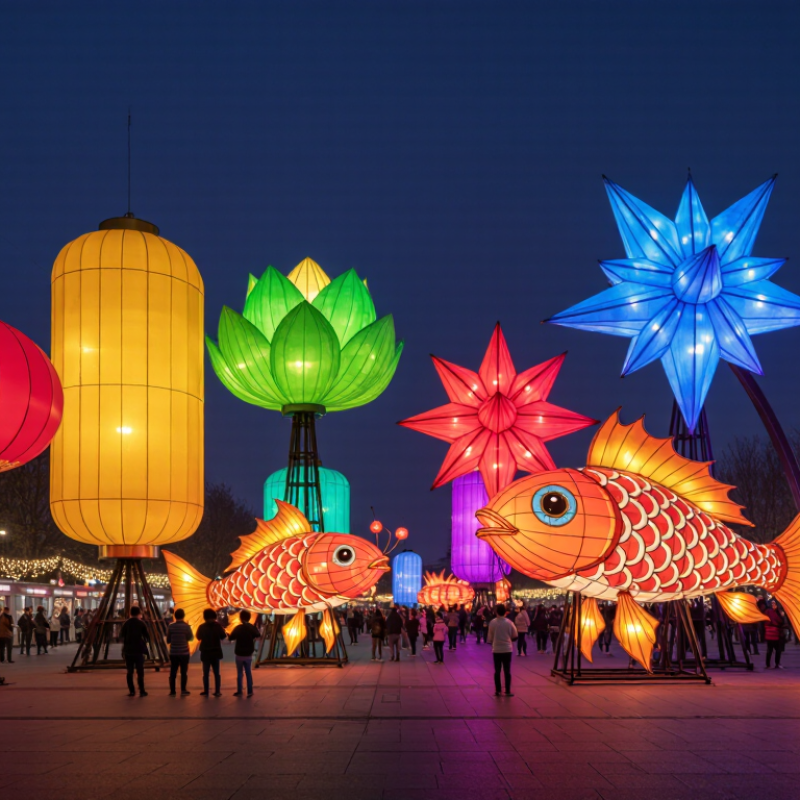
Classify Seven Giant Lantern Styles by Form, Scale, and Event Use
Giant lanterns work best when their shape matches the event’s movement and viewing distance. Spherical lanterns suit entrance plazas, where visitors can circle them. Arches and tunnels create a clear route through a night market or festival. Animal forms attract families, especially when placed beside open viewing areas. Floral lanterns add color to garden walks, but dense displays can hide smaller details.
Scale changes the experience. As a practical planning guide, compact pieces around 2–4 meters fit pathways; 5–8-meter centerpieces anchor open squares; larger walk-through scenes need generous clearance. These are working ranges, not industry standards.
Keep sightlines clear. Architectural lanterns work well as photo landmarks, while zodiac or character figures can mark themed zones. Landscape tableaux, with hills, trees, and figures, suit longer festival routes.
The Events Industry Council’s 2018 Global Economic Significance of Business Events study estimated 1.5 billion participants and $1.07 trillion in direct spending worldwide. Those figures describe business events, not lantern festivals, but they underline the value of designing for visitor flow.
Still, bigger is not automatically better. A tall lantern can dominate a small courtyard, while a carefully lit animal scene may invite closer viewing. Check sightlines after dark; daytime mock-ups can be misleading.
Compare Animal, Floral, Landmark, Traditional, and Interactive Designs
Animal, floral, landmark, traditional, and interactive lanterns each create a different focal point. Animal designs suit family events; a glowing tiger or crane can anchor a photo area. Floral forms soften formal dinners, especially with translucent petals and warm light. Landmark lanterns help visitors recognize a place, while traditional motifs bring cultural detail. Check that cultural symbols are represented respectfully. Small details matter.
Interactive designs invite visitors to move, touch, or pose, but need clear circulation space and sturdy construction. Eventbrite’s 2024 Social Study reported that 79% of Gen Z and millennial respondents felt live experiences helped them connect with others. That supports designing lanterns for shared moments, not just distant viewing. Still, bigger is not always better. A huge display can block sightlines or overwhelm a small venue; a slightly irregular handmade edge may feel more welcoming than perfect symmetry.
Tips: Match the lantern’s height to viewing distance, and test its colors under the venue’s actual lighting. Keep pathways open around installations, especially near entrances. For outdoor festivals, confirm weather suitability and secure the frame. Take a nighttime test photo; bright colors can look dull on camera, while reflective surfaces may glare. Don’t overdecorate. A little restraint helps each design stand out.
Match Lantern Size to Viewing Distance, Crowd Flow, and Venue Scale
A giant lantern should feel impressive without overwhelming its setting. Match its dimensions to the farthest viewing point, not just the entrance. For a courtyard, a lantern around two meters tall may read clearly from across the space. In a large field, a smaller piece can disappear against the night sky. Walk the site before choosing. A quick mock-up with a pole or marked outline can reveal awkward proportions.
Crowd flow matters as much as scale. Place lanterns where visitors can pause without blocking paths, exits, or accessible routes. At a narrow gate, one oversized display may create a bottleneck. Several smaller lanterns along a wider approach can spread attention more naturally. Keep enough space around each piece for people to gather and take photos. Sightlines change when crowds arrive, so leave room for real event conditions. My first estimate is often too optimistic.
Tips: Check visibility from both standing and seated height. Test the layout after dusk, when glare and shadows become obvious. Measure the widest route before installation, and confirm the lantern remains stable outdoors. If the venue feels crowded on paper, it probably will in practice.
LED Lanterns: U.S. DOE Reports at Least 75% Less Energy Use
LED lanterns can make oversized festival displays easier to illuminate without the heavy power demand of older incandescent lighting. The U.S. Department of Energy reports that LEDs use at least 75% less energy than incandescent bulbs. That comparison matters, but it is not a guarantee that every giant lantern will save exactly 75%. Actual use depends on its light output, operating hours, and electrical design.
For an event planner, the useful number is wattage. Check each lantern’s rated power, then multiply it by the hours it will run. A 20-watt LED operating for eight hours uses 160 watt-hours. Compare that figure with an equivalent incandescent setup, not with a smaller decorative lamp. Look for even illumination across fabric panels, secure wiring, and a dimming option for long evening displays. Small details matter.
LEDs also produce less heat than incandescent bulbs, which can be helpful around lantern materials. Still, inspect the product’s safety instructions and ventilation requirements; low heat does not mean no heat. Test the lantern after dark, when uneven patches and glare are easier to spot. A display may look bright in daylight and feel harsh at night. That part is easy to miss.
Check NFPA 701 Flame Testing and IEC 60529 Outdoor IP Ratings
When comparing seven giant lantern options for a festival, treat flame and weather documentation as part of the design—not fine print. NFPA 701 evaluates flame propagation in specified textile and film samples. It does not mean a lantern is fireproof. Ask for a current test report identifying the exact fabric, coating, and construction you plan to install. A report for similar-looking cloth may not cover seams, liners, or replacement panels. Details matter.
For outdoor use, check the IEC 60529 IP code on the complete electrical enclosure, not just a bulb or controller. IP65, for example, indicates dust-tight protection and resistance to water jets under test conditions. It is not a promise against every storm, standing water, or wind-driven rain. Inspect cable glands, plugs, access doors, and hanging points; one exposed connector can undermine an otherwise suitable setup. Keep test documents with installation notes, and have a qualified installer verify the actual arrangement. Match the report to what arrives. Packaging can change, and paperwork sometimes lags behind. That’s worth questioning.