
Who Are the Best Work Gloves Manufacturers in China?

Who are the best Work Gloves manufacturers in China? The answer depends on the job, the required protection, and the buyer’s quality standards. A factory suited to lightweight assembly gloves may not be the right fit for heavy-duty handling. Product range alone is not enough.

Compare manufacturers by more than catalog photos. Check stitching consistency, coating coverage, grip, sizing, and material specifications. Ask how samples are tested and whether production batches are inspected against written requirements. For example, a glove’s grip can feel reliable on a dry sample but perform differently when exposed to oil or moisture. Details count.

A strong supplier should provide clear product data, responsive communication, and documentation that buyers can verify. Confirm that any claimed certifications apply to the specific product and are current. If possible, review samples and discuss your use conditions before placing a large order. That sounds simple. It isn’t.

There is no universal ranking that suits every company. Prices, lead times, customization options, and quality-control practices can change. A polished catalog can hide gaps in production consistency; even careful checks cannot remove every risk. This guide explores notable Chinese manufacturers and practical ways to assess them, helping buyers build a shortlist based on evidence rather than marketing claims.
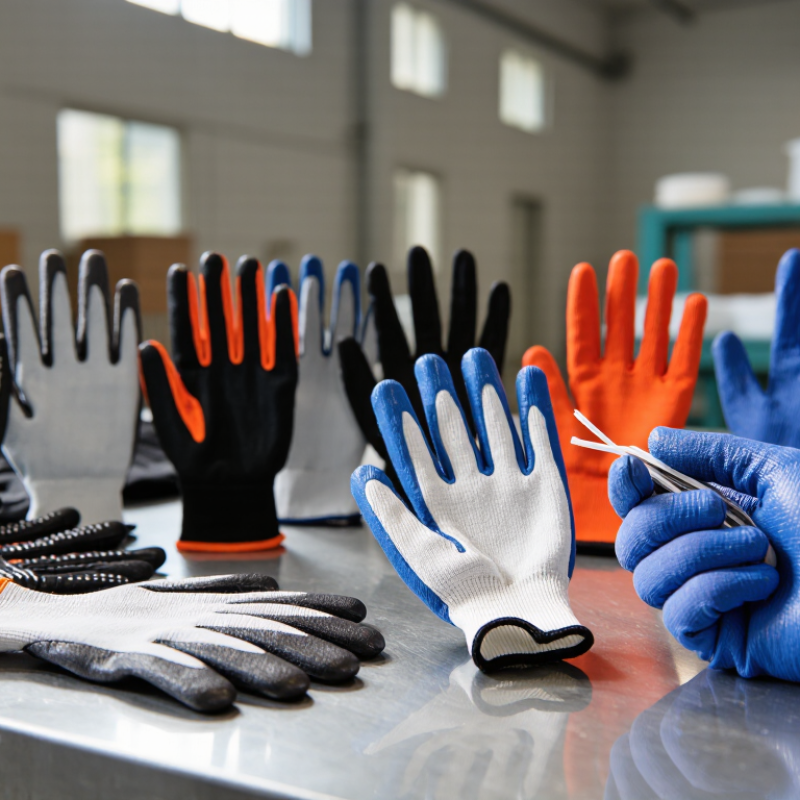
Who Are the Best Work Gloves Manufacturers in China?

Work Gloves in China: Main Product Types, Materials, and Industrial Uses

China’s work-glove market covers many product types, from light assembly gloves to heavier protective designs. Common options include knitted gloves with coated palms, cut-resistant gloves, leather gloves, and chemical-resistant gloves. Nylon and polyester liners feel light and flexible, while cotton can offer comfort for simpler handling tasks. Nitrile, latex, and polyurethane coatings provide different levels of grip and abrasion resistance. Fit matters. A glove that is too loose can make small parts harder to handle.

For sharp-edged sheet metal, buyers often consider cut-resistant liners made with aramid or other high-strength fibers. These materials do not make a glove cut-proof, and protection varies by construction. Leather gloves suit some rough handling and heat-related tasks, but leather thickness can limit finger movement. Nitrile or PVC coatings may help with oils or moisture; chemical protection depends on the specific substance and glove design. Not universal. A coating can improve grip yet reduce breathability, a trade-off that is easy to overlook.

Industrial uses range from warehouse picking and construction to automotive work, food handling, and metal fabrication. Buyers should match the glove’s material and coating to the task, not just its appearance or price. Check the cuff, seams, palm coverage, and sizing against the work process. A sample trial can reveal problems quickly: sweaty hands, slippery tools, or seams that rub after several hours. Those details deserve a second look.

How EN 388 Rates Gloves: Abrasion Levels 0–4 and Coup-Cut Levels 0–5

For buyers comparing work glove manufacturers in China, EN 388 markings offer a useful starting point. The abrasion rating runs from 0 to 4. It reflects how many abrasive cycles a glove withstands before wearing through: level 1 begins at 100 cycles, level 2 at 500, level 3 at 2,000, and level 4 at 8,000. Level 0 means it did not reach the first threshold. Higher is not automatically better. A thick, highly abrasion-resistant glove may feel clumsy during small-part assembly. Check the test report, not only the product description.

The Coup-cut rating runs from 0 to 5 and measures resistance to a rotating blade under specified test conditions. The levels correspond to increasing cut-index thresholds, from below 1.2 at level 0 to 20 or above at level 5. It is a useful comparison, but not a promise of protection in every workplace. Blade type, force, fit, and repeated use can change what workers experience. Real use is messier. Ask manufacturers for the EN 388 result, sample gloves, and details on the tested construction. Then try them on the actual task. A test level cannot tell you everything about grip or comfort.

How ANSI/ISEA 105 Classifies Cut Resistance: Levels A1–A9

When comparing work glove manufacturers in China, start with the cut-resistance test method, not a product slogan. ANSI/ISEA 105 uses the ASTM F2992 test to measure the force needed for a blade to cut through glove material. The result is reported in grams-force and grouped into levels A1 through A9. A1 covers 200–499 grams-force; A2, 500–999; and A3, 1,000–1,499. The ranges continue upward, with A4 at 1,500–2,199, A5 at 2,200–2,999, A6 at 3,000–3,999, A7 at 4,000–4,999, A8 at 5,000–5,999, and A9 at 6,000 or more.
Small numbers matter.

A higher level indicates greater cut resistance in this test, not protection against every sharp object or work condition. The chart looks tidy; real work is not. A glove can perform differently when wet, worn, stretched, or poorly fitted. Match the rating to the task, then check the product’s test report and sizing details. Ask whether the tested sample represents the glove construction you plan to buy. A number alone is not enough. A careful review should also consider grip, dexterity, seam quality, and whether workers can handle tools comfortably during a full shift.

Who Are China’s Leading Manufacturers? Compare Product Range and Production Capacity

China’s leading work glove manufacturers differ in product range and production capacity. Some focus on coated assembly gloves, while others make cut-resistant, leather, or cold-weather styles. A broad catalogue can help buyers consolidate orders, but it does not prove every model is produced in-house. Ask which processes are performed at the factory and which are subcontracted.

Capacity is more than a monthly figure on a sales sheet. Compare stated output with line count, shift schedules, workforce size, and recent delivery records. Request samples from the same product family you plan to order, then check coating coverage, seam strength, cuff finish, and sizing consistency. Details matter. A sample may be excellent while a bulk run varies. That risk deserves discussion.

For a fair comparison, use the same specifications with each manufacturer: glove material, coating type, size range, packaging, and target order volume. Ask for capacity by product category, not just total annual output. Review quality-control steps and how defects are recorded, while treating unsupported claims cautiously. No single factory is best for every buyer. Large capacity may suit repeat orders, while a smaller range can sometimes mean closer control; verify this through production records and pre-shipment checks.

How to Verify a Supplier: ISO 9001, Test Reports, and Sample Trials

When assessing work glove manufacturers in China, check the ISO 9001 certificate against the actual factory name, address, scope, and expiry date. Confirm it was issued by an accredited certification body. ISO 9001 indicates a quality management system, not proof that a glove meets a particular performance claim. Paper is not proof.

The ILO’s 2023 global estimates report 395 million non-fatal work-related injuries each year, underscoring why protective equipment needs careful evaluation. Request test reports for the exact glove model, including test date, methods, results, and laboratory details. For mechanical risks, check that the report identifies the applicable EN 388 requirements and ratings. Then test samples. Have intended users try several sizes during realistic tasks; inspect seams, grip, fit, and coating wear after repeated use. Record defects and compare samples across batches. A brief trial may miss problems, so extend it when the work is harsh or repetitive. A certificate can look reassuring, yet it cannot show that every shipment performs equally.

Back To Top