
Choosing an Amart Coffee Table involves more than matching a finish to your sofa. Buyers should compare dimensions, materials, storage, stability, and everyday cleaning needs. A compact apartment may suit a nesting design, while a larger living room can accommodate a broad table with a lower shelf. Measure the available floor space before browsing. Leave enough room to walk comfortably around the table.
This guide explores China-based coffee table manufacturers and suppliers, including the details that help buyers assess them. Look for clear product specifications, consistent photographs, stated material options, and practical information about packaging and lead times. Ask how surfaces handle common spills, how joints are assembled, and whether custom sizes affect minimum order quantities. Small details matter. A glossy image cannot confirm sturdy construction. Request samples or detailed inspection records when possible, and compare answers across suppliers rather than relying on a single sales claim. These checks do not guarantee a perfect order, but they make decisions more informed.
Supplier selection still requires judgment. A low quote may exclude packaging or customization, while a polished catalog may leave important questions unanswered. Not every supplier will fit every project. The following sections outline useful comparison points for retailers, hospitality buyers, and homeowners seeking dependable options. Use them as a starting point, then verify current specifications directly with each company.
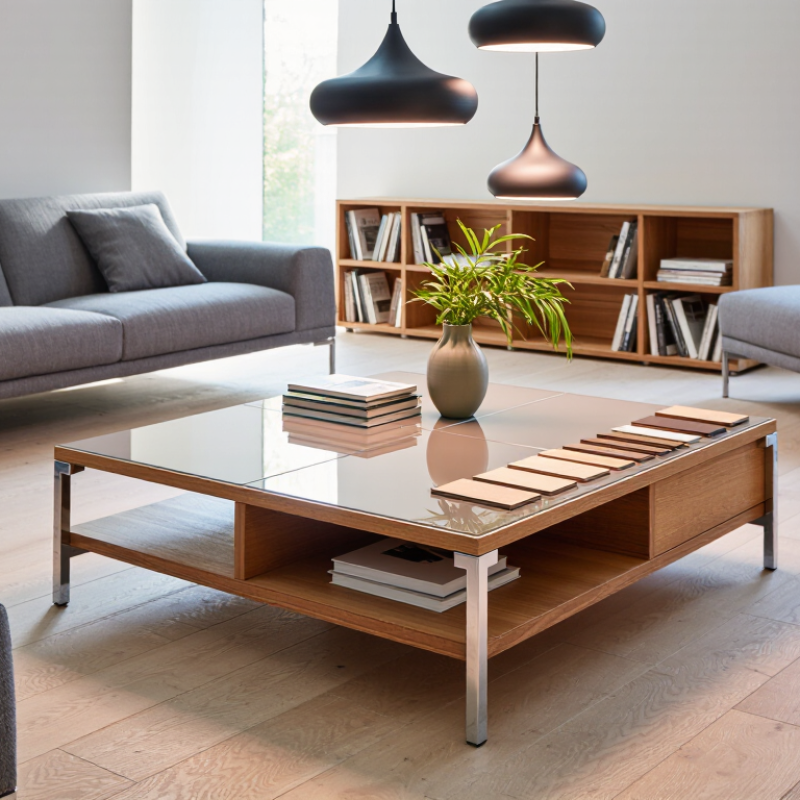
Coffee tables in this style are commonly designed at 40–50 cm high, a practical range for many living rooms. This height often sits near the sofa seat, keeping a mug, book, or remote within easy reach. “Common” does not mean universal. Seat cushions compress, and sofa frames vary.
Measure from the floor to the top of the seat cushion, then compare that figure with the table height. A tabletop near seat level can feel convenient; a slightly lower surface may keep sightlines open across the room. A 45 cm table might pair well with a 43 cm seat, but actual reach matters more than arithmetic. Check knee clearance and drawer access, too.
For China-based manufacturers and suppliers, clear specifications help prevent avoidable mismatches. Confirm whether the listed height includes the feet, and request a finished-product measurement rather than relying only on a drawing. Uneven floors can also make a table appear taller on one side. These details are easy to overlook. It is worth checking twice.
Material choice shapes an amart coffee table’s weight, stability, price, and daily upkeep. Solid wood offers visible grain and can be refinished, but panels need careful seasoning and secure joints to limit movement. MDF supports smooth paint and consistent shapes; sealed edges help resist spills and swelling. FAO’s 2022 Forest Products Yearbook records global wood-based-panel production at about 399 million cubic metres in 2021, reflecting a mature supply base. Still, production volume alone cannot confirm a panel’s grade or durability.
Metal frames can reduce bulk while providing firm support when welds and fasteners are well finished. World Steel Association data puts China’s crude-steel output at roughly 1.02 billion tonnes in 2023. That figure describes steel production, not furniture-grade tubing, so buyers should check tube thickness, coating, and load testing. Details matter. Tempered glass creates a bright, easy-to-wipe surface, but exposed corners need careful protection and stable supports.
For suppliers in China, construction details matter as much as the material list. Ask for panel thickness, wood moisture control, edge treatment, frame finish, and glass thickness in the specification sheet. Request sample checks for wobble, sharp edges, and uneven gaps. Not always. A mixed-material design can look refined, yet poor joining may loosen over time. I would still question vague claims such as “solid construction” unless drawings and test records support them.
| Material | Common Construction | Typical Advantages | Considerations | Useful Supplier Checks |
|---|---|---|---|---|
| Solid Wood | A solid-wood top joined to a wood or metal base; legs and aprons may use mortise-and-tenon, dowel, or other mechanical joinery. | Natural grain and character; can often be sanded and refinished; durable when properly made and maintained. | Wood expands and contracts with changes in moisture. Finish, species, and construction affect resistance to scratches, dents, and spills. | Ask for the wood species, whether parts are solid wood or veneer, finish details, moisture-control practices, and care instructions. |
| MDF | A medium-density fibreboard panel, often finished with paint, laminate, or wood veneer, attached to a wood or metal frame or base. | Smooth, uniform surface; suitable for painted finishes and consistent panel shapes; engineered panels can use wood fibres efficiently. | Standard MDF can swell if exposed to moisture. Edges and fastener locations need suitable finishing and secure construction. | Confirm panel thickness, surface finish, edge sealing, moisture-resistant specification if required, and applicable formaldehyde-emissions documentation. |
| Metal | A welded or mechanically assembled steel or aluminium frame, sometimes paired with a wood, MDF, stone, or glass top. | Can provide a slim, rigid support structure; metal finishes allow a range of appearances and are easy to wipe clean. | Finish can scratch or chip; exposed steel may corrode if its protective coating is damaged. Stability depends on frame geometry and joints. | Check the metal type, tube or sheet specifications, weld quality, coating process, corrosion protection, and whether floor-protecting feet are included. |
| Tempered Glass | A heat-treated glass top supported by a frame or secured with compatible pads, brackets, or fittings; it is commonly combined with a metal or wood base. | Provides a smooth, non-porous surface and a visually open appearance. Tempered glass is designed to be stronger than comparable annealed glass and, when broken, typically fragments into smaller pieces. | Can show fingerprints and scratches; edges and corners require careful handling. Glass can still break, and post-tempering cutting or drilling is not suitable. | Confirm glass thickness and edge treatment, tempering documentation, secure support points, protective packaging, and applicable product-safety requirements. |
Specifications vary by design and supplier. Request product drawings, material details, finish samples, and test or compliance documents relevant to the destination market.
A dependable coffee table begins with a measured production plan. Manufacturers translate drawings into panel dimensions, edge details, and hardware positions before CNC cutting starts. The machine follows programmed paths through sheet material, producing repeatable parts for tabletops, aprons, and legs. Operators still check each batch. A sharp bit can leave a cleaner edge, while worn tooling may cause small chips that need attention.
After cutting, workers label and sort components so assembly does not become a guessing game. Pilot holes, brackets, and fasteners are checked against the design. The frame is assembled on a level bench, and diagonal measurements help reveal whether it sits square. Small gaps matter. A table can look straight in a photograph yet rock slightly on a real floor, so fit checks should happen before finishing.
Surface finishing protects the material and shapes the final feel. Technicians sand exposed edges, remove dust, then apply coatings in controlled layers. Between coats, they inspect for uneven sheen, rough patches, or visible sanding marks. Drying time cannot be rushed without consequences. Still, workshop conditions vary, and a flawless finish is not guaranteed on every piece. Careful handling, consistent inspection, and clear records help suppliers identify problems before the table is packed.
Example planning allocation of production time by stage
This illustrative model allocates production time across CNC cutting, assembly, and surface finishing. Actual proportions vary with table design, materials, finish requirements, and factory processes.
For Chinese coffee table suppliers, quality checks should connect the product specification to repeatable test evidence. CEN’s EN 12521 sets safety, strength, and durability requirements for domestic tables, while EN 1730 specifies test methods for stability, strength, and durability. Ask for the laboratory report, not only a “passed” statement. It should identify the tested model, materials, dimensions, test setup, applied loads, cycles where relevant, and recorded results.
Look closely at the table’s weak points: a narrow pedestal base, a glass-to-frame joint, or a shelf fixed with small fasteners. Ask whether the sample matched the production design. A report for a heavier prototype may not represent the shipped table. Useful measurements include applied force in newtons, deformation in millimetres, and any movement or damage observed during testing. The standards define the test approach; the appropriate load and sequence depend on the product and test method.
For stronger traceability, request a report from a laboratory accredited to ISO/IEC 17025:2017 for the relevant testing scope. Check its report number, sample photos, test date, and standard editions against the purchase specification. These details make supplier comparisons more objective. Still, paperwork has limits. A test cannot fully capture every uneven floor or years of rough handling. Sources: CEN, EN 12521 and EN 1730; ISO/IEC 17025:2017.
When comparing China’s coffee table manufacturers, treat MOQ, lead time, customization, and export capacity as linked measures. Grand View Research estimated the global furniture market at USD 677.09 billion in 2022, with projected growth through 2030. That broad market figure is not coffee-table-specific, but it signals why buyers should verify production slots rather than assume fast delivery. Ask for separate lead times for sampling, production, and peak-season orders. A low MOQ may apply only to standard finishes; custom stone tops, metal frames, or special cartons can raise minimums.
Customization is easiest to assess through a written specification: dimensions, finish samples, edge details, hardware, and packaging. Request a pre-production sample and confirm who pays for revisions. For export capacity, check recent shipment records, carton measurements, loading plans, and experience with your destination market. The World Bank’s 2023 Logistics Performance Index ranked China 19th, with a score of 3.7 out of 5. This is a country-level benchmark, not proof of any factory’s performance. Verify each supplier directly.
Tips: Compare like with like. Send the same drawing, quantity, finish, and delivery terms to every supplier. Ask for a dated production schedule and photos of packed goods. Small details get missed. I’d still allow buffer time; even a clear schedule can slip when materials arrive late.