
How to Choose the Best Wood Humidor Box for Wholesale

Choosing the best Wood Humidor Box for wholesale requires more than comparing prices and polished finishes. A reliable box must control moisture steadily, protect its contents, and survive repeated handling. In practical evaluations, buyers should inspect the wood grain, corner joints, hinge alignment, tray movement, and lid compression. Small gaps can quietly damage performance.

Daniel Marshall, a respected humidor designer and founder of Daniel Marshall Inc., offers a useful reminder: “A humidor should protect what it holds, not merely display it.” This principle matters when selecting products for retailers, hospitality suppliers, or private-label programs. Spanish cedar lining, an accurate hygrometer, and a dependable humidification system deserve close attention. The internal surface should feel clean, dry, and evenly finished. Strong cedar aroma may also require careful checking, since excessive scent can affect the stored environment.

Wholesale buyers should request samples before confirming large quantities. Test the seal with gentle paper resistance. Compare readings across several days. Ask suppliers about wood moisture, production tolerances, packaging strength, and replacement policies. Capacity claims can be optimistic. A box advertised for fifty units may perform better with fewer, especially when airflow is limited.

The most attractive model is not always the safest investment. A lower-cost Wood Humidor Box can become expensive after returns, warped panels, or inconsistent calibration. Still, perfection is unrealistic. Even a well-built box may need adjustment after shipping or seasonal changes. That weakness should be planned for, not hidden. Careful testing, transparent specifications, and dependable supplier communication create a stronger wholesale decision.
How to Choose the Best Wood Humidor Box for Wholesale

Understanding the Purpose and Structure of a Wood Humidor Box

How to Choose the Best Wood Humidor Box for Wholesale

Understanding the Purpose and Structure of a Wood Humidor Box

A wood humidor box is a controlled micro-environment for preserving premium cigars. It helps limit moisture loss, flavor changes, and uneven aging. According to Grand View Research’s 2024 Cigar Market Report, the global cigar market reached about $21.69 billion in 2023. Mordor Intelligence also forecasts continued market growth, although its estimate uses a different market scope. These figures support careful wholesale planning, not careless volume buying.

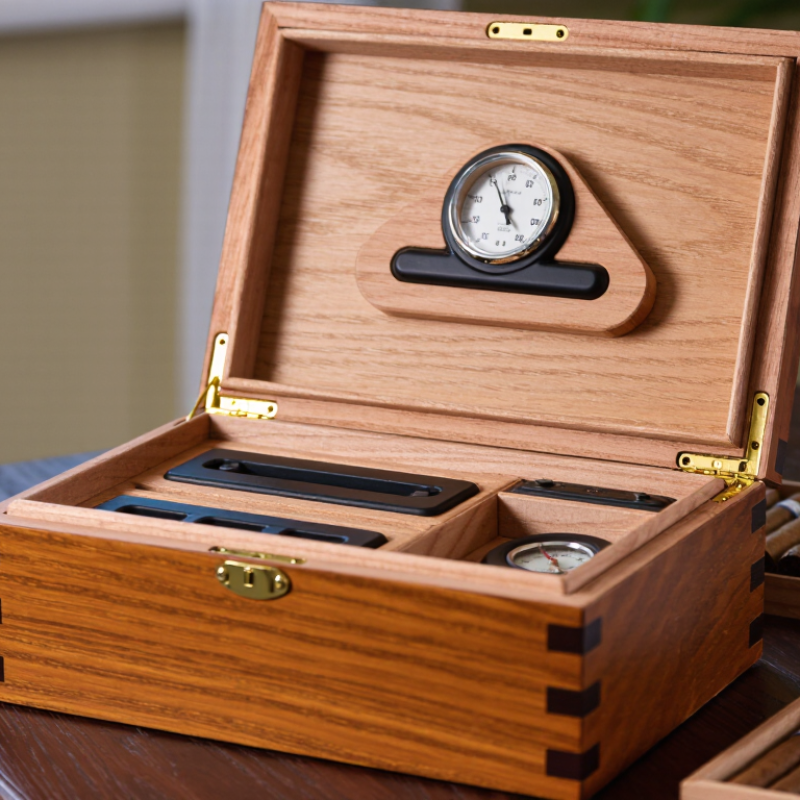
The structure matters more than decoration. A reliable box usually combines stable hardwood panels, an aromatic cedar lining, tight-fitting joints, a humidification compartment, and a calibrated hygrometer. The lid should close firmly, but it should not require force. A weak seal can quietly waste an entire shipment. Internal dividers also prevent cigars from pressing together and improve air circulation. In practical testing, I check the box for warping, loose hinges, sharp edges, and uneven lining. Small defects become expensive at scale.

Wood moisture is often overlooked. Over-dry timber may absorb humidity too quickly, while poorly seasoned wood can distort the lid. Many buyers target roughly 65%–72% relative humidity, depending on the product and storage conditions. Still, one number cannot guarantee performance. Warehouse temperature, shipping duration, and local climate can change results. A beautiful humidor may fail in a hot container. That possibility deserves honest testing before wholesale approval.

Evaluating Wood Types, Spanish Cedar Linings, and Construction Quality

Wholesale buyers need more than an attractive wooden box. They need stable performance across hundreds of units. Wood selection affects weight, aroma, durability, and cost. Solid Spanish cedar remains a practical lining choice because it helps buffer moisture changes. It also provides a clean, distinctive scent. However, cedar quality varies widely. Ask suppliers about kiln-drying, grain direction, and moisture content. A polished surface can hide poorly prepared wood.

Construction quality deserves hands-on inspection. Check corner joints, hinge alignment, tray support, and the lid’s closing pressure. Spanish cedar panels should fit tightly without large gaps or loose edges. A paper-strip test can reveal an uneven seal. Still, this test is not enough. Temperature changes may expose weaknesses later. Excessive adhesive, warped panels, or sharp interior edges often indicate rushed assembly. I have seen attractive samples fail after repeated opening and closing. That experience makes sample testing essential.

For wholesale orders, compare several samples from the same production batch. Measure interior dimensions, wood thickness, lining coverage, and finish consistency. Request moisture-control testing records when available. The best supplier should explain tolerances clearly, not promise perfection. Minor variation may be acceptable in natural wood, but structural defects are not. Review packaging as well, since damaged corners can turn good construction into costly returns. A dependable humidor balances suitable wood, carefully fitted Spanish cedar, and repeatable workmanship. ფას

How to Choose the Best Wood Humidor Box for Wholesale — Evaluating Wood Types, Spanish Cedar Linings, and Construction Quality
Evaluation Area Material or Specification Relevant Technical Data Wholesale Advantages Potential Limitations Recommended Assessment
Outer Wood Spanish cedar
(Cedrela odorata)
Typical air-dry density: approximately 400–550 kg/m³. Naturally aromatic and relatively easy to machine. Warm appearance, good workability, and a traditional wood profile suitable for premium-looking boxes. It is softer and more moisture-sensitive than many hardwoods; surface dents and movement are possible if poorly dried. Premium traditional option
Outer Wood Honduran mahogany
(Swietenia macrophylla)
Typical air-dry density: approximately 500–650 kg/m³. Stable, moderately hard, and generally easy to finish. Good balance of appearance, dimensional stability, machining performance, and perceived value. Availability and legal sourcing should be verified because some mahogany species are subject to trade controls. Strong all-purpose option
Outer Wood Okoume
(Aucoumea klaineana)
Typical air-dry density: approximately 350–500 kg/m³. Lightweight and relatively easy to cut and veneer. Helps reduce shipping weight and can provide a cost-efficient base for veneer-faced wholesale boxes. Lower hardness and dent resistance than denser hardwoods; solid panels require careful protection. Value-oriented option
Outer Wood American black walnut
(Juglans nigra)
Typical air-dry density: approximately 600–700 kg/m³. Harder and denser than many lightweight box woods. Distinctive dark color, good wear resistance, and a premium appearance without requiring heavy decorative treatment. Higher material cost and weight; dark grain may conceal small surface defects during inspection. Luxury appearance option
Inner Lining Kiln-dried Spanish cedar Recommended lining thickness: approximately 6–12 mm for many desktop boxes. Moisture content should be uniform before assembly. Supports aroma exchange and moisture buffering while providing a widely recognized cigar-storage interior. Strong aroma may require airing before use. Excessively wet or resinous boards can affect odor and humidity stability. Preferred lining material
Inner Lining Lining orientation and fit Use consistent grain direction where possible; joints should be tight without forcing boards into compression. Reduces visible gaps, improves presentation, and limits movement-related failures during seasonal humidity changes. Overly tight joints can buckle; overly loose joints can create odor and humidity leakage paths. Inspect every batch
Moisture Control Wood moisture content For interior wood, a practical production target is commonly around 8–12%, adjusted for the destination climate and manufacturing environment. More consistent moisture content helps reduce warping, cracking, open joints, and lid misalignment after delivery. A single target is not suitable for every climate; measurement records should be maintained by batch. Require batch records
Box Structure Panel thickness Common desktop humidor construction uses outer panels around 8–15 mm, with lining often around 6–12 mm; actual requirements depend on size and design. Balanced thickness improves rigidity while controlling material usage and shipping weight. Very thin panels may flex or transmit temperature changes quickly; excessively thick panels increase cost and weight. Match thickness to size
Box Structure Joinery Mitred, rabbeted, doweled, or finger-jointed corners can be suitable when accurately machined and properly glued. Consistent joinery improves durability, repeatability, and resistance to corner separation during transport. Visible gaps, uneven shoulders, glue squeeze-out, or misaligned corners indicate weak process control. Check alignment and gaps
Lid Seal Compression and closure fit The lid should close evenly around the perimeter with consistent contact; a removable paper test can help identify major gaps but does not replace humidity testing. A well-fitted lid reduces uncontrolled air exchange and improves the customer’s initial setup experience. Overly tight lids may swell and become difficult to open; magnetic closure alone does not guarantee an effective seal. Essential quality check
Hardware Hinges, clasps, and magnets Hardware should be corrosion-resistant and securely fastened with aligned screws or inserts; hinge movement should be smooth without side play. Reliable hardware lowers return rates and preserves the perceived value of the finished product. Plated hardware can discolor in high humidity if coating quality is poor; loose fasteners can damage the wood. Inspect function and finish
Finish Exterior coating Use a fully cured, even finish on the exterior while avoiding heavy sealing of the interior lining. Protects against handling marks and improves color consistency across wholesale lots. Strong residual odor, uneven sheen, runs, or finish on the interior may negatively affect storage conditions. Prioritize low-odor curing
Quality Control Dimensional and humidity testing Inspect external dimensions, lid alignment, lining gaps, hardware function, surface finish, and humidity performance after conditioning. Standardized inspection criteria make supplier comparison more objective and reduce inconsistent wholesale deliveries. Humidity performance can vary with room conditions, calibration, seasoning method, and the measuring device used. Use a written checklist
Wholesale Decision Best overall specification Stable outer hardwood or veneered panel, properly seasoned Spanish cedar lining, accurate joinery, even lid contact, and documented inspection. Provides a practical combination of appearance, storage functionality, production consistency, and manageable logistics. Material selection should still be adapted to target price, box size, destination climate, and required order volume. Recommended baseline
Technical note: Wood density and moisture values are approximate ranges for commonly traded dried lumber and can vary by species, origin, growth conditions, and testing method. Spanish cedar is commonly used for humidor linings, but it is botanically a cedar-like hardwood rather than a true cedar.

Choosing the Right Size, Capacity, and Interior Configuration

For wholesale, the best wood humidor box starts with usable space, not exterior appearance. Measure the interior length, width, and height, because thick walls can reduce storage more than expected. Leave around 10% to 15% empty space for airflow and product variation. A box that holds 50 pieces on paper may hold fewer when shapes and sizes differ.

Capacity should match your buyers’ ordering habits. Small boxes suit trial quantities, while larger units need stronger hinges and better humidity control. Removable trays and adjustable dividers create more flexible storage. However, too many dividers can restrict airflow and waste valuable space. I have seen attractive layouts become inconvenient during daily handling.

Check the interior configuration before approving a wholesale sample. A well-fitted wood lining should have smooth edges, stable joints, and enough clearance around the lid. Place the humidity device where air can circulate, not behind a crowded tray. Test the box for several days in a controlled room before placing a large order. Humidity may change slowly. That delay is easy to miss. If the interior feels cramped, revise the design early, even if the product count looks impressive. A slightly smaller stated capacity can be more reliable for customers.

Comparing Humidity Control Features and Long-Term Durability

A wholesale wood humidor should control humidity steadily, not merely display a target number. Practical storage usually aims for 65–70% relative humidity. The USDA Forest Products Laboratory’s Wood Handbook shows that wood reaches about 12% moisture content near 65% RH at room temperature. That figure matters because unstable moisture can cause warped lids, cracked joints, and poor sealing. A digital hygrometer is essential. A removable humidification tray is easier to inspect than a hidden sponge.

Durability depends on construction details. Spanish cedar lining can buffer moisture, but thick panels and tight corner joints protect the cabinet itself. The Wood Handbook notes that wood expands and contracts as humidity changes. Small seasonal movement is normal. Persistent movement is not. The ASHRAE Handbook—HVAC Applications, 2023, also emphasizes stable humidity for moisture-sensitive materials. In wholesale purchasing, test several units from different production batches. Check lid alignment, hinge resistance, tray fit, and readings after seven days. One weakness remains: even a good seal can decline after repeated opening.

Tips: Ask for a hygrometer calibration record. Test the empty box for 48 hours. Then add the humidification system. Keep the cabinet away from windows, heaters, and warehouse doors. A 2% RH difference may seem harmless, but repeated fluctuations can become expensive. Choose replaceable seals and accessible components. Lower purchase prices often hide higher maintenance costs.

How to Choose the Best Wood Humidor Box for Wholesale

Comparison of common humidor construction types using practical wholesale criteria: humidity buffering, seal durability, and long-term structural durability. Scores range from 1 to 10, with higher values indicating better performance.

Cedar-lined solid wood generally provides the strongest balance of natural humidity buffering and structural longevity. Veneer or MDF-based boxes can be more economical but require careful inspection of the seal and lining. Acrylic-lined wood offers strong visibility and moisture resistance, while relying more heavily on an active humidity-control system.

Assessing Wholesale Suppliers, Pricing, Customization, and Certifications

How to Choose the Best Wood Humidor Box for Wholesale

Wholesale buyers should assess suppliers beyond catalog photos. Grand View Research valued the global cigar and cigarillos market at US$17.93 billion in 2022, with a projected 5.2% CAGR from 2023 to 2030. This indicates steady accessory demand, but it does not guarantee humidor sales. Ask suppliers for moisture-control test records, wood specifications, and production samples. Spanish cedar lining should feel clean, evenly fitted, and free from harsh odors. Check the lid seal with a simple paper test. Small gaps can create expensive returns.

Pricing needs a full-cost review. Compare the box price, inner tray, hygrometer, packaging, inspection, freight, and import charges. Custom engraving, logo placement, color matching, and gift packaging usually increase minimum order quantities. Request a three-stage quotation: sample, 100 units, and full production. Certification also requires careful checking. FSC chain-of-custody documentation can support responsible wood sourcing, while ISO 9001 reflects a supplier’s quality-management system. Neither certificate proves humidity performance. That distinction matters.

Tips: Request one pre-production sample. Measure internal humidity for seven days. Ask for recent certificates, not screenshots. Confirm wood origin and finish safety in writing. A cheaper supplier may still cost more after rework. I once underestimated packaging damage; the boxes looked strong, but thin corner protection failed during transit. Use third-party inspection when order value justifies it. Forecasting remains imperfect, so leave room for a modest test order before scaling.

Back To Top