How to Choose an Inline Duct Fan Motor?
Choosing an Inline Duct Fan Motor is not just a matter of matching a diameter. The motor must move enough air through the real duct system, including bends, filters, grilles, and dampers. A fan rated for impressive airflow in open air may deliver much less once resistance rises. The difference matters in a quiet bedroom, a warm attic, or a workshop with a long exhaust run.
Building-science educator Allison Bailes, PhD, emphasizes looking at HVAC performance as a whole system. A practical paraphrase of that approach is: “Choose for the airflow the installed system needs, not the fan’s headline rating.” This guide applies that principle to motor type, speed control, static pressure, power supply, noise, and operating conditions. EC motors can offer efficient, adjustable operation; AC motors may suit simpler setups. Neither is automatically the better choice. Check the manufacturer’s performance curve and confirm compatibility with the controller before buying.
Small details count. A fan that fits the duct but cannot overcome resistance may leave rooms stuffy. A powerful motor can add unwanted noise or consume more energy than necessary. Specifications help, but they do not replace measuring the duct or checking the installation. That is an easy step to overlook. The right choice balances airflow, pressure, efficiency, control, and service life—and sometimes the available product data still leaves questions worth investigating.
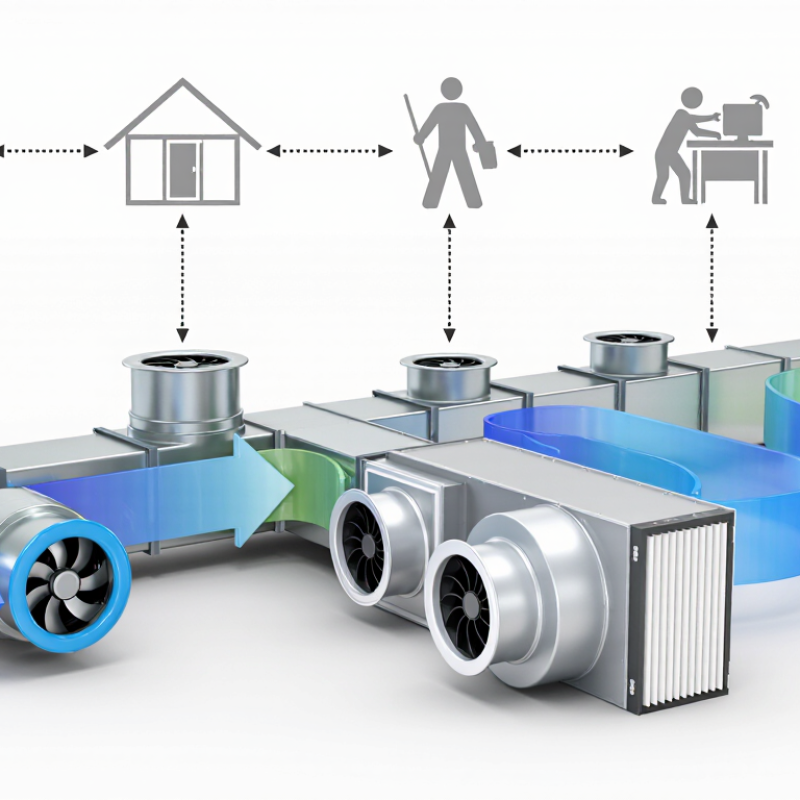
Understand Inline Duct Fan Motor Types and Ratings
Inline duct fans commonly use AC induction, permanent-split-capacitor (PSC), or electronically commutated (EC) motors. AC and PSC designs are familiar options; EC motors combine a motor and electronic control, often enabling finer speed adjustment. But “EC” alone does not guarantee energy savings. Actual consumption depends on operating hours, settings, and duct resistance. A restrictive filter can change the picture.
Read the motor nameplate for voltage, input watts, speed, and duty information. Then check the fan’s airflow and static-pressure ratings at your actual operating point. AMCA Standard 210/ASHRAE 51 sets laboratory methods for measuring fan airflow and pressure.
The IEA’s 2011 report, Energy-Efficiency Policy Opportunities for Electric Motor-Driven Systems, estimates that motor-driven systems use about 45% of global electricity. That broad figure makes efficiency worth checking, but it does not predict one fan’s savings. I treat a motor label as a starting point, not a verdict.
Tips: Check the IP rating and permitted operating temperature for dusty or humid ceiling spaces. Compare sound levels at the required airflow, not only at maximum speed. Published airflow may assume low resistance; measure duct pressure on site when possible.
Define Required Airflow, Static Pressure, and Operating Conditions
Choose an inline duct fan motor from measured system demand, not the fan’s free-air airflow rating. Record the required airflow in cubic feet per minute, then estimate static pressure from duct length, bends, grilles, dampers, and filters. A narrow elbow or a dirty filter can add meaningful resistance. Use the fan curve to confirm that the selected fan can deliver the airflow at that pressure. Free-air figures alone do not show this.
Measure, do not guess. The U.S. Department of Energy’s Improving Fan System Performance sourcebook reports that optimizing fan systems may reduce energy use by 20% to 50% or more; that is potential savings, not a promise for every installation. The AMCA 210 test standard describes laboratory methods for measuring fan airflow, pressure, and power, making certified performance data more useful than an isolated marketing figure. Check operating temperature, altitude, air density, and expected run time, too. These conditions affect motor load and cooling. A first pressure estimate can be wrong, especially when a filter loads up. Leave room to revisit it after installation, using measured airflow and pressure rather than sound or feel.
Compare Motor Speed, Efficiency, and Control Options
Choose an inline duct fan motor by matching airflow, pressure, and control needs—not by speed alone. A fixed-speed AC motor is simple and often costs less, but it cannot adjust smoothly when a filter loads with dust. Multi-speed models offer basic flexibility. Electronically commutated motors (ECMs) can provide finer speed control and use less power at reduced airflow, though their controls may add cost. A quiet room matters. So does the fan’s real operating point.
Compare efficiency under the conditions you expect, not just the motor’s peak rating. The U.S. Department of Energy’s Improving Fan System Performance sourcebook reports that fan systems account for about 15% of electricity used in U.S. manufacturing. That broad figure is not a forecast for one duct fan, but it shows why efficient operation matters. Check the fan curve, sound rating, and power draw at your target airflow. Then confirm that a wall controller or building control signal is compatible; a mismatched controller can cause humming or unstable speed. Specs can still be imperfect.
Tips: Measure the duct and note bends, grilles, and filter resistance. Choose a motor with usable speed adjustment, then test airflow at the installed setting. A lower speed may save energy, but not if the room stays stuffy.
How to Choose an Inline Duct Fan Motor? - Compare Motor Speed, Efficiency, and Control Options
| Motor type | Typical speed behavior | Typical motor efficiency | Common control options | Best suited for | What to check before choosing |
| PSC (permanent split capacitor) AC | Usually runs near a speed set by the motor’s pole count and supply frequency; actual speed drops somewhat under load. | Often about 40–70% for small fan motors; varies with motor size and operating load. | May support speed adjustment with a compatible voltage controller or manufacturer-approved control. Not every PSC motor is suitable for every controller. | Straightforward installations where a moderate-cost motor and simple speed adjustment are sufficient. | Confirm controller compatibility, minimum stable speed, motor temperature limits, and whether reduced speed still provides the required airflow. |
| EC (electronically commutated) DC | Electronically controlled, often with a wide adjustable speed range; available speeds and adjustment method depend on the fan’s control interface. | Often about 60–85% for small fan motors; efficiency depends on size, speed, and load. | Common options include a potentiometer, 0–10 V input, PWM, or a compatible digital control. Interfaces are model-specific. | Applications needing efficient variable-speed operation, scheduled ventilation, or integration with a control system. | Check the exact input signal, wiring, power supply requirements, control range, and compatibility with building controls. |
| Three-phase AC induction | Speed is primarily set by supply frequency and motor pole count; a variable-frequency drive can provide adjustable speed within the motor’s limits. | Often about 70–90% for small-to-medium motors, with higher efficiencies generally more common in larger motors. | Fixed-frequency operation or a compatible variable-frequency drive (VFD). | Commercial or industrial systems with three-phase power and a need for robust, adjustable operation. | Verify available supply, motor/VFD compatibility, required protection, installation requirements, and the permitted operating-speed range. |
Selection note: Efficiency figures are broad indicative ranges for small-to-medium motor types, not guarantees for a particular fan. Compare the fan’s airflow at the required duct-system static pressure, power input, sound level, control compatibility, and rated operating range before selecting a motor.
Check Electrical, Mounting, and Environmental Compatibility
An inline duct fan motor must match the actual supply, not just the fan’s advertised wattage. Check the nameplate for voltage, phase, frequency, current, and speed. IEC 60034-1 defines normal operating Zone A as ±5% voltage and ±2% frequency variation. Treat those limits as guidance, not a reason to ignore a poor match. A supply outside the motor’s rating can affect starting and performance. Worth a second check.
Mounting details matter just as much. Compare the motor’s frame, bolt pattern, shaft size, and orientation with the fan housing. Leave room for wiring, airflow, and future service; a motor that fits only when pressed against a duct is not a practical fit. Use fan airflow and pressure data tested under ANSI/AMCA 210 and ANSI/ASHRAE 51 methods. Those lab results help with comparison, though installed duct resistance can change the outcome.
Then assess the room itself. Dust, moisture, heat, and chemical vapors can shorten motor life. IEC 60529 defines IP5X as dust-protected and IPX5 as protected against water jets; neither rating alone confirms suitability for every site. Match the enclosure rating to real exposure, and check the motor’s temperature limits. I may be cautious here, but an overlooked damp corner can matter more than a small efficiency difference.
How to Choose an Inline Duct Fan Motor
Check electrical, mounting, and environmental compatibility before selecting a replacement motor.
These are common nominal AC supply voltages, not a list of interchangeable motor ratings. Match the motor nameplate voltage and frequency to the available supply, then confirm the mounting dimensions and permitted installation orientation. Check the motor’s ambient-temperature limits and required enclosure or ingress protection for the installation environment.
Match Motor Specifications to Fan Size and Maintenance Needs
How to Choose an Inline Duct Fan Motor?
Match the motor to the fan’s duty point, not just its duct diameter. Start with required airflow and the system’s static pressure, including filters, bends, grilles, and long duct runs. Then check the fan curve to confirm the motor can maintain that airflow without operating near its limit. Verify voltage, phase, speed control, mounting, and continuous-duty rating. A motor that fits physically may still be wrong electrically.
Speed changes matter. The ASHRAE Handbook—Fundamentals describes fan power as varying approximately with the cube of speed under similar conditions. A 10% speed increase can therefore raise power demand by about 33%. Choose a motor with suitable capacity, but avoid sizing by guesswork; an oversized motor can waste energy and complicate control. AMCA Publication 201, Fans and Systems, also highlights how installation effects can alter fan performance. The real duct layout matters.
Maintenance needs should shape the choice too. In dusty rooms, inspectable or replaceable parts can save time; for continuous operation, check bearing type, thermal protection, and the motor’s rated duty. Keep access panels clear, and record airflow and noise after installation. A neat specification sheet can still miss a clogged filter or an awkward service location. This is easy to overlook. Check the actual operating conditions before finalizing the motor.