
Choosing a wholesale backpack supplier can shape your product quality, margins, and delivery schedule. A polished catalog is only a starting point. The real test comes when samples arrive, specifications are checked, and production deadlines approach. A zipper that catches or a strap that pulls unevenly can turn a promising order into an expensive lesson.
This guide uses an illustrative quote from fictional sourcing specialist Daniel Mercer: “A reliable supplier proves quality in the sample, then repeats it in production.” This is an editorial line, not a verified quotation from a real industry expert. The principle is practical: compare materials, stitching, hardware, and finished measurements before committing to a large order. Ask how the supplier handles samples, minimum order quantities, customization, lead times, and quality checks. Get clear answers in writing.
Details matter. A little skepticism helps. Price deserves attention, but it should not decide everything. A low quote may leave out packaging, customization costs, or inspection steps. Request specific product details, confirm who handles changes, and check whether promised delivery dates match your selling calendar. Communication matters too. Notice how quickly the supplier answers—and whether the answers are precise.
The tips ahead offer a grounded way to evaluate a wholesale backpack partner, from reviewing product consistency to assessing service after delivery. No checklist can remove every risk. Still, careful questions and a physical sample can reveal problems early, before they reach your customers.
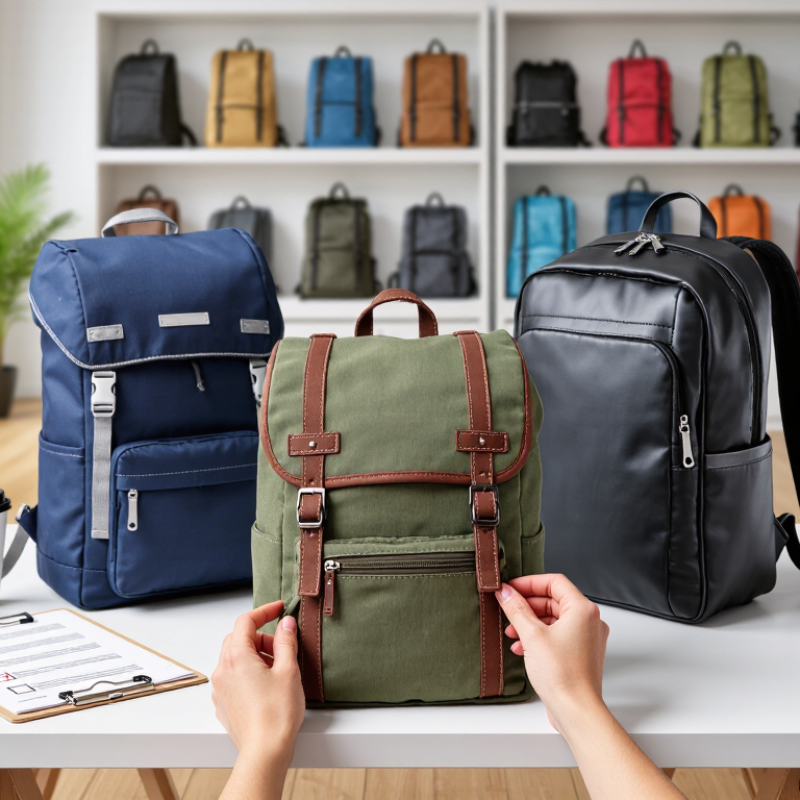
Before asking for quotes, define who will carry the backpack and where they will use it. A school bag needs space for books, a lunch container, and perhaps a laptop; a commuter pack may need a padded sleeve and quick-access pockets. For context, the U.S. National Center for Education Statistics reported 49.6 million students enrolled in public elementary and secondary schools in fall 2022. That is a large potential audience, not a forecast of backpack sales. The Outdoor Industry Association’s 2024 Outdoor Participation Trends Report counted 175.8 million U.S. outdoor participants in 2023, or 57.3% of the population. Outdoor participation also does not equal demand for hiking packs. Start with use. Then test your assumptions.
Turn the target market into measurable specifications: capacity in liters, dimensions, empty weight, fabric, zipper type, and required compartments. A 20-liter school pack and a 35-liter hiking pack serve different needs, even if both have padded shoulder straps. Ask prospective buyers what they carry, how far they walk, and what price feels reasonable. Their answers may challenge your first design. That is useful. Give suppliers a written brief, sample reference measurements, and acceptable tolerances. Ask whether they can produce and inspect those details consistently, including seam strength and strap attachment points. If you have not tested a loaded sample, do not treat a product photo as proof of comfort or durability.
Typical capacity ranges can help you match product specifications to your target users. These are planning guidelines, not fixed standards; actual needs vary by user, trip length, and gear.
A wholesale backpack supplier should prove more than a low price. Ask how many years it has produced bags, which construction methods it handles, and whether its current workshop can meet your order volume. Request recent production records, sample lead times, and a clear explanation of peak-season limits. Then compare answers with a small trial order. Check stitching at stress points, zipper movement, lining alignment, and whether cartons match the agreed packing plan. Small details reveal habits.
Capacity is not just a monthly output figure. Ask how the supplier schedules materials, handles rework, and reports delays, then verify those claims against dated production updates. The World Bank’s 2023 Logistics Performance Index assessed 139 economies across six areas, including tracking and tracing and timeliness. It is not a factory rating, but it highlights why shipment visibility and dependable delivery deserve direct checks. Request sample tracking records and references from buyers with similar order sizes. A polished audit sheet helps, but it cannot answer every question. One uneven sample may be a mistake; repeated defects deserve attention. Reflect on your own requirements, too: an urgent launch date may leave little room for a supplier still learning your specifications.
A reliable wholesale backpack supplier should let you inspect a production sample, not just a glossy fabric swatch. Check the denier and weave, then look closely at seam consistency, zipper movement, strap attachment, and lining edges. Ask for abrasion, colorfastness, and load-test results, including the test method and sample size. Small details matter. I would not judge fabric by hand feel alone; that shortcut can mislead. Carry a loaded sample and check whether the straps twist or the base sags.
Material claims deserve evidence. Textile Exchange’s Materials Market Report 2024 estimates global fiber production reached 124 million tonnes in 2023, with polyester representing 57% of production. That scale makes clear material specifications important: ask suppliers to identify fiber composition and provide traceability documents for recycled content. The Circularity Gap Report 2024 estimates that only 7.2% of materials used globally come from recycled sources. A recycled label alone does not prove a backpack will last. Ask for documentation, and compare construction as well as content.
Customization affects quality, too. Request a pre-production sample showing your chosen fabric, lining, thread, colors, and logo placement. Confirm color matching tolerances, minimum order quantities, and who pays for revisions. Ask whether changing fabric weight alters the pattern or stitching. Not just a swatch. Keep the approved sample and written specifications as references; suppliers can interpret “heavy-duty” differently, and I have seen that phrase cause avoidable confusion.
| Tip | What to Evaluate | How to Verify It |
|---|---|---|
| 1. Inspect construction quality | Look for even stitching, secure seam finishes, neatly attached handles, and consistent assembly. Stress points such as shoulder-strap joints and top handles generally need reinforcement. | Request a production sample and inspect seams, attachments, and finishing. Ask whether the supplier performs in-line and final inspections, and what defects are checked. |
| 2. Compare material specifications | Confirm the exact fabric type, fiber composition, fabric weight or denier where applicable, lining, and coating. A higher denier alone does not guarantee a more durable backpack; construction and intended use also matter. | Ask for written material specifications and a fabric swatch. Compare the sample with the specification, and request test results when material performance is important to the product. |
| 3. Check zippers and hardware | Evaluate zipper operation, stitching around zipper tape, buckle closure, adjusters, and other hardware. Components should be suitable for the backpack’s intended load and frequency of use. | Open and close each zipper repeatedly on a sample. Adjust the straps, test buckles, and check that hardware edges do not snag or damage the fabric. |
| 4. Assess comfort and fit | Review shoulder-strap width and padding, adjustability, back-panel construction, and handle comfort. Design needs can differ for school, travel, work, and outdoor use. | Test a loaded sample with the intended users or load range. Check strap adjustment, balance, and whether the pack stays comfortable during normal movement. |
| 5. Confirm capacity and dimensions | Compare external measurements, stated volume, compartment layout, and laptop or document fit. Capacity figures may be measured differently, so the method and usable space matter. | Request a dimensioned specification sheet and measure a sample. Place representative items inside to confirm fit, access, and compartment usability. |
| 6. Review customization options | Check available choices for colors, fabrics, linings, pockets, labels, embroidery, printing, and packaging. Custom options may affect tooling, minimum order quantities, cost, and production time. | Request a written list of available options, setup charges, minimums, and artwork requirements. Approve a pre-production sample showing the selected materials and decoration. |
| 7. Ask about testing and product claims | Match testing to the product’s intended use. Relevant checks may include seam strength, colorfastness, abrasion resistance, water resistance, or testing of restricted substances when required by the destination market. | Ask for dated reports that identify the tested material or product and the test method. Verify that any water-resistance claim describes the actual test and does not imply that the backpack is waterproof without supporting evidence. |
| 8. Understand order quantities and lead times | Clarify minimum order quantities by style, color, and customization level, along with sample time, production time, and peak-season capacity. | Request a written schedule with key milestones, including sample approval, material sourcing, production, inspection, and shipment. Confirm how changes or delays will be communicated. |
| 9. Compare the full landed cost | Consider unit price as well as sampling, customization, packaging, freight, duties, and inspection costs. Confirm the currency, payment terms, quote validity, and delivery terms. | Ask for an itemized quotation and compare equivalent specifications and shipping terms. Check which costs are included and which may be charged separately. |
| 10. Establish quality and communication processes | A dependable supplier should be able to document specifications, manage revisions, identify production issues, and explain how nonconforming goods are handled. | Agree on a written specification, approved sample, inspection criteria, and corrective-action process before production. Evaluate response clarity and consistency during the quotation and sampling stages. |
A low unit price can hide costs that change the real value of a backpack order. Ask each supplier for a written quotation based on the same materials, dimensions, and quantity. Check whether prices include sample fees, packaging, freight, and any setup charges. Small details matter. A quote for a basic nylon bag is not comparable to one with reinforced stitching and custom pockets.
Minimum order quantities affect both cash flow and storage. Ask whether the minimum applies to each color, design, or total order. For example, 500 bags may sound manageable, but 500 per color could leave you with slow-moving stock. Request a smaller trial run if available, then compare its unit price with the standard order. The higher sample cost may still be worthwhile. I’d avoid assuming that a supplier will make an exception without confirming it in writing.
Payment terms deserve the same attention as price. Confirm the deposit, balance due date, accepted payment methods, and what happens if production is delayed. Ask when the order is considered approved and whether changes after approval create extra charges. Keep the quotation, order details, and payment schedule together. A spreadsheet helps, but it may not capture every surprise; review the terms with someone responsible for purchasing before sending a deposit.
A low unit price can lose its appeal when cartons arrive late or in poor condition. Ask the backpack supplier for a realistic production timeline, dispatch date, and estimated transit range. Request the shipping method, carton dimensions, gross weight, and tracking process in writing. Dates matter. Check who handles export paperwork and what costs may arise at your destination. A sample shipment or recent, redacted shipping record can help you compare promises with actual handling.
Compliance needs clear, product-specific answers. Ask for material descriptions, care-label details, and test reports relevant to the backpack’s intended market. Confirm that report models, colors, and materials match the items you plan to order; a certificate for a similar bag may not cover yours. Requirements vary by destination and product, so verify them with a qualified local adviser when details are unclear. Paperwork can look convincing and still be incomplete.
After-sales support shows its value when zippers fail or cartons arrive short. Ask how to report defects, what evidence is needed, and how claims are resolved. Get response times and remedies in writing, including replacement, credit, or repair options. Keep photos, packing lists, and inspection notes from delivery day. I still find vague promises easy to accept during negotiations, so build a simple claim process into the purchase order before placing a large order.