
Top 10 10t Trackless Vehicle Manufacturers for Global Buyers

Choosing a 10t Trackless Vehicle is not simply a matter of comparing prices and load ratings. Global buyers need to examine turning space, floor strength, battery performance, braking control, and after-sales support. A vehicle carrying ten tonnes may look powerful in a factory photograph. Its real value appears on a narrow route, beside a loading bay, or during a twelve-hour production shift.

Industrial transport consultant Martin Lenz states, “A rated load is useful only when the route, floor, and duty cycle support it.” That practical view matters. Specifications can seem impressive, yet small details often decide daily reliability. Wheel material affects floor protection. Steering design influences cornering accuracy. Charging time can quietly reduce production capacity.

This guide examines the Top 10 10t Trackless Vehicle Manufacturers for Global Buyers. It considers engineering experience, manufacturing consistency, customization capability, safety features, and international service networks. The comparison also looks beyond brochures. How does each manufacturer handle uneven floors? Can the vehicle integrate with factory scheduling systems? Are spare parts available without painful delays?

No ranking can fit every operation. That is the uncomfortable truth. A steel mill may value rugged traction, while a warehouse may prioritize compact steering. Some manufacturers communicate clearly. Others leave important operating limits uncertain. Buyers should therefore verify test data, warranty terms, delivery records, and local technical support before signing an order.

The strongest choice is not always the most expensive one. It is the vehicle that performs predictably, shift after shift, under the buyer’s actual working conditions.
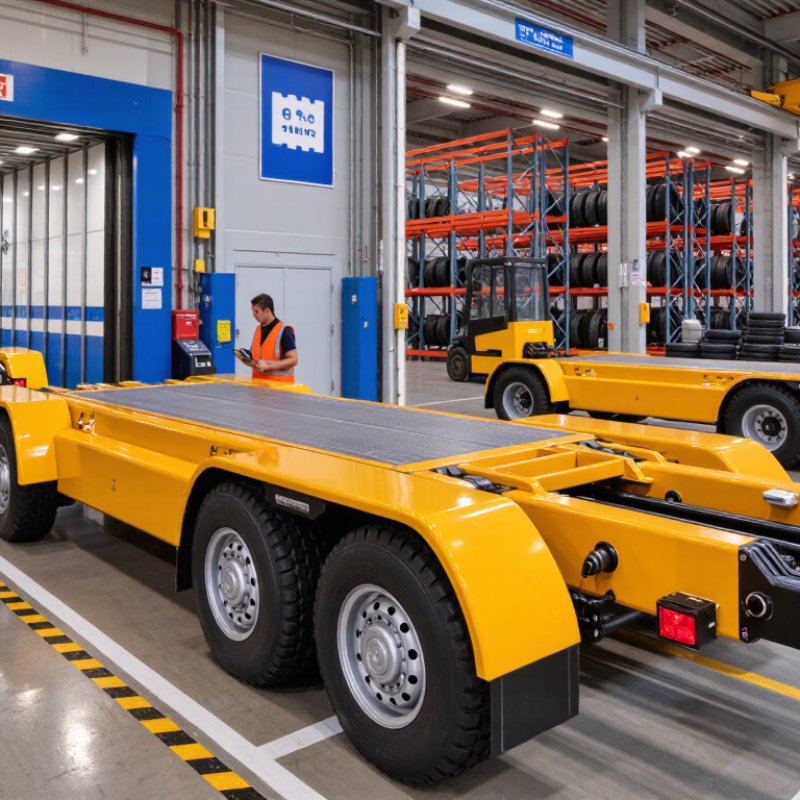
Top 10 10t Trackless Vehicle Manufacturers for Global Buyers

10-Ton Trackless Vehicle Specifications: 10,000 kg Payload and Load Capacity

A 10-ton trackless vehicle is rated to carry 10,000 kg, equal to approximately 98.1 kN under standard gravity. This figure describes the maximum payload, not the vehicle’s total operating mass. If the empty vehicle weighs 7,500 kg, its loaded gross mass reaches about 17,500 kg. That affects braking, steering, tire pressure, and floor loading.

Real capacity depends on more than the label. A 10,000 kg steel coil placed near one side can create higher wheel loads than evenly distributed cargo. Ramp gradients, turning speed, load height, and center of gravity also reduce practical capacity. ISO 3691-4:2023 emphasizes risk controls for driverless industrial trucks, including stability, sensing, and safe operating zones. Buyers should request rated capacity curves, axle-load limits, braking distances, and test conditions.

Energy use matters during repeated transport cycles. The International Energy Agency reported that electric truck sales increased strongly in 2023, supported by falling battery costs and expanding charging infrastructure. However, a battery-powered 10-ton vehicle may lose range under heavy payloads, cold temperatures, or frequent ramps. That limitation is easy to overlook. The World Bank’s Logistics Performance Index 2023 also shows that dependable logistics depend on reliability, not capacity alone. Confirm floor bearing strength, charging time, duty cycles, and emergency controls before comparing manufacturers. A larger number is not always better.

Global Manufacturer Selection Criteria: Safety, Drive Systems, and Duty Cycles

Selecting a 10-ton trackless vehicle requires more than comparing lifting capacity. Global buyers should verify rated load, braking distance, steering control, and emergency stopping performance under real floor conditions. ISO 3691-4:2020 provides a useful safety framework for driverless industrial trucks, including risk assessment, protective systems, and operating zones. A serious manufacturer should explain test methods, not only provide attractive specifications.

Drive systems deserve close inspection. Electric traction suits factories needing low noise and precise movement. Differential steering can reduce turning space, while independent wheel control may improve maneuverability on uneven routes. However, higher complexity can increase service demands. The International Federation of Robotics reported 541,302 industrial robots installed worldwide in 2023. This signals stronger automation adoption, but a trackless vehicle still needs reliable integration with doors, charging stations, sensors, and traffic controls.

Duty cycle calculations often reveal the real difference between manufacturers. Buyers should record payload, route length, floor slope, starts per hour, and battery charging windows. A vehicle moving 10 tons for twelve short trips differs greatly from one operating continuously across three shifts. Battery chemistry, motor cooling, tire wear, and regenerative braking must match that workload. MHI’s 2024 Annual Industry Report identified robotics and automation as major supply-chain investment priorities, yet forecasts can mislead when local conditions are ignored. In practice, a controlled site trial is more valuable than a polished brochure. Mistakes still happen. That is why buyers should request maintenance records, safety validation, and documented performance under peak duty cycles.

Top 10 Manufacturers Compared by 10-Ton Performance and Customization

Selecting among the top 10 trackless vehicle manufacturers requires more than checking a 10-ton payload label. Buyers should compare tested capacity, duty cycle, traction, braking distance, and steering accuracy. A vehicle carrying steel coils needs different engineering from one moving warehouse pallets.

The International Federation of Robotics reported 541,302 industrial robots installed worldwide in 2023. This figure shows the wider shift toward automated material handling. However, robot adoption data does not prove heavy-vehicle reliability. Each manufacturer should provide load-test records, battery performance, maintenance intervals, and software validation. Look closely at gradeability, turning radius, obstacle detection, and charging time. Small details matter.

Customization separates similar suppliers. Strong candidates can adjust deck dimensions, tow hitches, lifting platforms, navigation methods, and control interfaces. ISO 3691-4 offers a useful safety reference for driverless industrial trucks, including risk controls and operating zones. A credible supplier should explain how its 10-ton model performs under uneven floors, narrow aisles, and repeated starts.

Published specifications are not perfectly comparable. Some ratings describe static capacity, not continuous movement. That weakness deserves attention. Buyers should request an on-site trial with the intended load, route, slopes, and stopping points. A practical comparison should also measure energy use per trip, recovery time after faults, and operator training hours. Performance is proven on the factory floor.

Top 10 10t Trackless Vehicle Manufacturers for Global Buyers - Top 10 Manufacturers Compared by 10-Ton Performance and Customization
Rank Manufacturer ID Rated Payload Drive Configuration Typical Battery Option Maximum Speed Gradeability Minimum Turning Radius Trackless Navigation Customization Level Safety Standards Overall Score
1 Manufacturer A 10,000 kg Four-wheel electric drive 72 V / 400 Ah lithium-ion 25 km/h 8% 5.5 m Laser and magnetic guidance High CE, ISO 12100 9.2/10
2 Manufacturer B 10,000 kg Dual-motor differential drive 80 V / 400 Ah lithium-ion 22 km/h 7% 4.8 m SLAM and QR-code navigation Very High CE, ISO 3691-4 9.0/10
3 Manufacturer C 10,000 kg Hydraulic steering with electric drive 72 V / 500 Ah lithium-ion 20 km/h 6% 6.2 m Magnetic tape and reflector guidance High CE, ISO 12100 8.8/10
4 Manufacturer D 10,000 kg Four-wheel steering 80 V / 300 Ah lithium-ion 18 km/h 8% 4.5 m Natural-feature and laser navigation Very High CE, ISO 3691-4 8.7/10
5 Manufacturer E 10,000 kg Two-wheel drive with mechanical steering 72 V / 400 Ah lead-acid or lithium-ion 20 km/h 6% 6.0 m Magnetic and wire-guided operation Medium-High CE, ISO 12100 8.4/10
6 Manufacturer F 10,000 kg Four-wheel electric drive 72 V / 600 Ah lead-acid 16 km/h 5% 6.8 m Magnetic tape guidance High CE, ISO 12100 8.2/10
7 Manufacturer G 10,000 kg Independent wheel drive 80 V / 400 Ah lithium-ion 18 km/h 7% 5.2 m SLAM and reflector navigation High CE, ISO 3691-4 8.1/10
8 Manufacturer H 10,000 kg Rear-wheel drive with front steering 72 V / 400 Ah lead-acid 15 km/h 5% 7.0 m Wire and magnetic guidance Medium CE, ISO 12100 7.9/10
9 Manufacturer I 10,000 kg Four-wheel electric drive 72 V / 450 Ah lithium-ion 17 km/h 6% 6.4 m QR-code and magnetic guidance Medium-High CE, ISO 12100 7.8/10
10 Manufacturer J 10,000 kg Dual-motor electric drive 72 V / 300 Ah lithium-ion 14 km/h 5% 6.6 m Magnetic tape guidance Medium CE, ISO 12100 7.6/10
Comparison criteria include rated payload, drive performance, battery configuration, maneuverability, navigation capability, customization potential, and commonly specified safety compliance. Actual specifications may vary by vehicle configuration, operating environment, battery selection, and regional certification requirements.

Compliance Review: ISO 3691-4, IEC 60204-1, and IP Protection Ratings

For global buyers comparing 10-ton trackless vehicle manufacturers, compliance evidence deserves more attention than polished specifications. ISO 3691-4 addresses safety for driverless industrial trucks and their systems. Review navigation behavior, pedestrian detection, emergency stopping, load stability, and operating zones. Ask for the risk assessment, not only a certificate.

IEC 60204-1 focuses on the vehicle’s electrical equipment. Check wiring identification, protective bonding, control circuits, emergency-stop functions, and fault response.

IP ratings should match real conditions. An IP54 enclosure may resist dust and splashing, but it is not fully waterproof. The rating also applies to a defined enclosure, not automatically to every component.

A checklist can look complete and still miss cable damage during daily charging.

Tips: Request test reports linked to the exact vehicle configuration. Verify rated-load stopping distances on the intended floor surface. Confirm whether safety functions were tested with maximum payload.

Review software version control and maintenance instructions. Keep records of factory acceptance tests and site commissioning. Documents may be translated poorly; clarify critical terms with the manufacturer’s engineer.

That extra call is worthwhile. Some buyers overlook battery isolation, especially on older designs. This deserves a second review.

A credible supplier should explain limitations, provide traceable evidence, and accept reasonable independent inspection before shipment.

Global Buyer Guide: Pricing, Service Coverage, Lead Times, and ROI Metrics

Top 10 10t Trackless Vehicle Manufacturers for Global Buyers

When comparing ten-ton trackless vehicle manufacturers, price should never stand alone. Factory quotations commonly range from $35,000 to $120,000, depending on battery type, steering control, deck size, safety sensors, and customization. Ask whether installation, operator training, spare parts, and export packaging are included. A low quote may hide costly exclusions.

Lead times often run from eight to twenty weeks. Custom designs usually take longer. Confirm production milestones in writing, including drawing approval, factory testing, shipment, and commissioning. Service coverage matters after delivery. Check for regional technicians, remote diagnostics, response times, and local spare-part stock. A reliable supplier should provide load charts, braking data, battery-cycle expectations, and maintenance intervals. Vague answers deserve caution.

ROI depends on real operating conditions. Measure current labor hours, transfer frequency, travel distance, floor quality, and daily payload cycles. A vehicle saving two workers may recover its cost within two to four years, but this estimate can fail during seasonal downtime. Include charging infrastructure, battery replacement, floor repairs, insurance, and lost production during service. I would also test turning behavior with a full ten-ton load, not an empty platform. That detail is easy to miss. The best comparison uses total cost per moved ton, annual availability, and verified service performance rather than purchase price alone.

Back To Top