
Who Are the Top Aluminum Profile Manufacturers in China?

China’s aluminum sector is broad, but a manufacturer’s real strengths show up in the details. A clean showroom sample tells only part of the story. Buyers also need to examine alloy options, extrusion tolerances, die-making capability, and consistency across production runs. For architectural projects, surface finish matters too: a small color shift between batches can stand out across an entire façade.

This guide to “Who Are the Top Aluminum Profile Manufacturers in China?” compares suppliers through practical criteria, not promotional claims alone. It considers product range, quality controls, finishing services, production capacity, and export experience. Metallurgist Cyril Stanley Smith wrote, “The history of metals is the history of civilization.” That broad observation is a useful reminder of how deeply material choices shape the built environment, though it is not a supplier-rating rule.

Look for evidence. Ask about sample testing, inspection records, packaging, and how a factory handles custom dies. A capable supplier should explain its process clearly, from billet selection to final inspection. Some companies may excel at large-volume standard profiles; others may suit smaller, customized orders. There is no perfect ranking for every buyer. Even a careful comparison can miss a detail that matters later. That is why the manufacturers discussed here should be assessed against your drawings, project requirements, and delivery plans—not name recognition alone.
Who Are the Top Aluminum Profile Manufacturers in China?

What Aluminum Profiles Are and How They Are Made

Aluminum profiles are shaped sections used in window frames, doors, furniture, machine guards, and building facades. Their hollow chambers and ribs can provide strength without adding unnecessary weight. A profile’s shape affects how it carries loads, connects to other parts, and handles water or heat. Not every design works everywhere. A slim frame may look neat but flex too much in a wide opening.

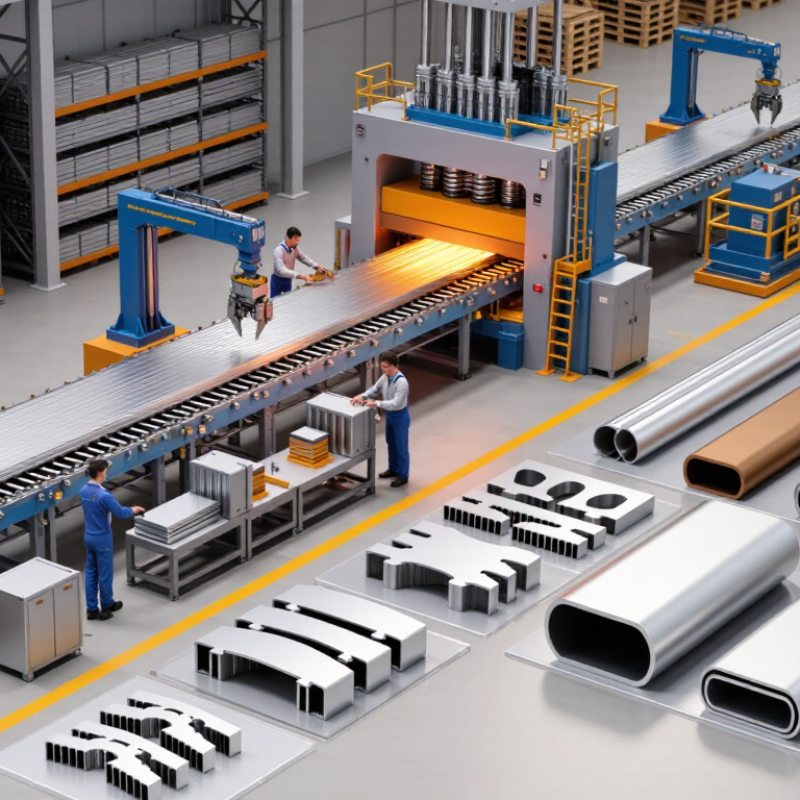
Most profiles are made by extrusion. Aluminum billets are heated, then pushed through a steel die that forms the cross-section. The emerging length is cooled, stretched to reduce distortion, and cut into manageable pieces. Heat treatment can improve strength, while machining adds holes or precise edges. Surface finishing, such as anodizing or coating, can improve appearance and resistance to wear. Small variations can still occur, so measurements and finish should be checked against project requirements.

Tips: Match the profile’s wall thickness and alloy to its actual use, not just its appearance. Ask for dimensional tolerances and finish samples. A sample helps, though it cannot reveal every production issue.

What Aluminum Profiles Are and How They Are Made

Typical processing temperature ranges for 6xxx-series aluminum profiles

Aluminum profiles are shaped by forcing a heated billet through a die. The chart shows representative temperature ranges for common stages in processing 6xxx-series alloys; actual settings vary with alloy, profile design, and production method.

How China’s Aluminum Profile Industry Is Organized

China’s aluminum profile industry is organized as a layered supply chain, not a single category of factory. Upstream suppliers provide aluminum billet, the cylindrical feedstock heated before extrusion. Extrusion plants press heated billets through shaped dies to make frames, rails, and structural sections. The die defines the profile.

Many producers focus on standard sections, while others create dies for customer-specific dimensions. Profiles then move to finishing shops for anodizing, powder coating, cutting, drilling, or assembly. Some firms manage several stages in-house; others rely on nearby specialist workshops. This division can shorten delivery routes, but it may also make quality checks less consistent. A smooth coating does not prove accurate dimensions.

Factories often cluster around industrial regions with access to metal suppliers, skilled operators, and freight links. Buyers may work with a mill directly or through trading and fabrication companies, depending on order size and support needs. Request alloy and temper details, dimensional tolerances, finish samples, inspection records, and a small trial batch. Paperwork helps. Real samples reveal more. One weakness in this structure is its complexity: the company quoting a profile may not control every production step.

Which Manufacturers Lead China’s Aluminum Profile Market

China’s aluminum profile market is led less by one dominant producer than by several manufacturer groups. Large integrated extruders serve construction, transport, and industrial customers. Specialized producers compete through tight dimensional tolerances, custom dies, and consistent alloy performance. Regional factories also benefit from nearby suppliers and customers, particularly in southern and eastern manufacturing hubs.

Scale matters, but it is not the whole story. China’s National Bureau of Statistics reported 41.5 million metric tons of primary aluminum production in 2023. That figure describes upstream metal, not finished profiles, so it should not be mistaken for a profile-market ranking. Buyers should compare extrusion capacity, surface-treatment quality, testing records, and delivery reliability. The picture is not perfectly neat: published rankings often use different methods, and some focus on revenue while others measure output.

Tips: Request a sample with the actual alloy, finish, and wall thickness. Check straightness and coating consistency under direct light. Ask for recent test reports and confirm whether quoted capacity is available for your order.

What Products and Industries These Manufacturers Serve

Chinese aluminum profile manufacturers serve very different needs, from standard building sections to tightly engineered custom shapes. Their product ranges often include window and door frames, curtain-wall members, heat-sink fins, rails, and structural tubes. Many can also provide cutting, drilling, CNC machining, anodizing, or powder coating. These steps matter. A profile for a coastal window may need a durable finish, while an electronics enclosure may depend on precise dimensions and effective heat transfer.

Construction remains a major application, including façades, partitions, and residential frames. Transport suppliers use lightweight sections in vehicle interiors, rail components, and equipment housings. Solar projects rely on mounting rails and brackets, while manufacturers of lighting and machinery may need specialized channels or heat sinks. The exact capabilities vary. Ask for drawings, alloy and temper details, dimensional tolerances, and finish samples before comparing quotations. A glossy catalog is not proof of consistent production. I would also check how a supplier handles sample approval and changes between batches. That step is easy to overlook, yet a small fit problem can slow an assembly line.

Who Are the Top Aluminum Profile Manufacturers in China? - What Products and Industries These Manufacturers Serve

Representative manufacturer categories and capabilities in China’s aluminum extrusion sector. This is a product-and-industry overview, not a company ranking; available specifications vary by manufacturer.

Manufacturer category Typical products Common materials and processes Industries served Typical purchasing considerations
Architectural profile specialists Window and door frames, curtain-wall sections, façade profiles, and other building-system extrusions Commonly use 6063-series aluminum alloys; may offer anodizing, powder coating, and other surface finishes Residential and commercial construction, façade engineering, and building renovation Check profile drawings, dimensional tolerances, finish options, applicable building requirements, and compatibility with the intended system
Industrial extrusion producers Standard and custom shapes, channels, angles, tubes, bars, and structural framing profiles May process 6061- and 6063-series alloys; capabilities can include cutting, drilling, machining, and surface finishing Machinery, automation, equipment frames, material handling, and general manufacturing Confirm alloy and temper, mechanical-property requirements, section dimensions, straightness, and secondary machining needs
Thermal-break system suppliers Insulated window, door, and façade profiles designed with a thermal barrier between interior and exterior aluminum sections Typically combine aluminum extrusions with a polymer thermal-break strip; may provide coated or anodized finishes Energy-conscious building projects, commercial construction, and residential fenestration Request system-level thermal and structural data, barrier specifications, air- and water-performance information, and compatible hardware details
Solar and electrical-profile producers Solar-panel frames, mounting rails, brackets, heat sinks, and equipment enclosures Extruded aluminum shapes may be cut or machined to length and supplied with finishes suited to the application Solar energy, power electronics, lighting, and electrical equipment Verify fit with the relevant module or equipment design, load requirements, corrosion exposure, finish, and production consistency
Transport and mobility suppliers Structural sections, rails, trims, tubes, and lightweight components for vehicles and transport equipment Alloy, temper, extrusion design, and any post-extrusion treatment depend on the component’s strength and fabrication requirements Automotive, rail transport, commercial vehicles, and related equipment manufacturing Assess material traceability, mechanical testing, dimensional control, joining compatibility, and any customer-specific quality requirements
Fabrication-focused profile manufacturers Custom extrusions supplied with operations such as CNC machining, punching, drilling, cutting, or assembly May combine extrusion with machining and finishing, including anodizing or powder coating through in-house or partner processes Construction, industrial equipment, retail fixtures, furniture, and consumer-product manufacturing Clarify drawing revision control, machining tolerances, inspection criteria, packaging, and whether finishing is performed in-house or outsourced

How to Compare Chinese Aluminum Profile Manufacturers

Comparing Chinese aluminum profile manufacturers starts with the part’s actual use, not a sales brochure. Share the alloy, temper, cross-section drawing, required tolerances, and annual volume. Then ask whether the factory can extrude that shape consistently. A narrow channel with thin walls may need different die design and process control than a simple rectangular tube. Details matter. Request a sample and inspect its dimensions, straightness, surface finish, and fit with adjoining components. A polished sample alone proves little; production consistency matters more.

Check how each supplier documents quality. Ask for material certificates, inspection records, and a clear explanation of how defects are handled. If the profile needs anodizing or powder coating, confirm coating specifications and review a finished sample under ordinary lighting. Ask about die ownership, tooling charges, sample lead time, and realistic production schedules. Written answers help prevent misunderstandings. Also compare packaging: profiles can arrive scratched if separators and end protection are inadequate. Not always. A low unit price may exclude tooling, finishing, or stricter inspection. Compare quotations line by line, and verify claims with records where possible. Communication can be imperfect, even with a capable factory; clarify ambiguous measurements before approving production.

Back To Top