
Top Fuel Rubber Hose Manufacturers for Global Buyers

Choosing a Fuel Rubber Hose manufacturer is not just a price comparison. Global buyers need products that match the fuel, operating pressure, temperature range, and installation environment. A hose used near a hot engine, for example, faces different demands from one fitted to stationary equipment. Small details matter. Reinforcement layers, inner-tube materials, bend radius, and end connections can affect service life and fit.

This guide examines manufacturers through practical purchasing criteria, including product range, technical documentation, quality controls, customization, and export support. Buyers should request current datasheets and confirm that stated performance applies to the exact hose construction they plan to order. Ask how batches are identified and what testing records accompany shipments. Clear answers help reduce uncertainty. They do not remove it entirely.

Supplier claims deserve careful review. A polished catalogue cannot replace samples, documented specifications, or direct discussion with an engineering contact. No shortlist is perfect. Lead times may change, and a suitable product can still be a poor match for a particular system. This overview is designed to help global buyers compare options more consistently, identify useful questions, and make decisions based on verifiable information rather than broad promises.
Top Fuel Rubber Hose Manufacturers for Global Buyers

What Top Fuel Rubber Hoses Are and Where They Are Used

A fuel rubber hose is a flexible passage that carries gasoline or diesel between a tank, pump, engine, and related components. Some hoses also return unused fuel or route fuel vapour. They use fuel-resistant rubber or elastomer layers, often supported by textile or other reinforcement. The exact construction matters: a hose must suit the fuel, pressure, temperature, and installation location. That detail is easy to overlook.

Fuel hoses appear in passenger cars, trucks, buses, farm machinery, boats, and stationary generators. OICA’s 2023 production report records 93.5 million motor vehicles produced worldwide, showing the scale of vehicle systems that depend on reliable fluid connections. The U.S. Energy Information Administration’s January 2024 Short-Term Energy Outlook estimated global petroleum and other liquids consumption at 101.9 million barrels per day in 2023. These figures describe broad demand, not hose sales, but they help explain why dependable fuel delivery remains important. Small engines matter, too.

In practice, a hose may run beside a warm engine, bend around a frame, or face vibration for years. Fit and routing are as important as material choice. A hose that looks sound can still be unsuitable for a particular fuel or operating pressure. Check for cracks, swelling, soft spots, and leaks, and follow the equipment maker’s specifications. Inspection helps, but it cannot reveal every internal defect.

How Materials and Construction Shape Hose Performance

A fuel hose’s inner tube must suit the fuel it will carry. Nitrile rubber is common, but fuel blends and operating temperatures affect compatibility. Fluoropolymer liners can reduce permeation in some designs, though they may add cost and require careful fitting. Compatibility matters. A material name alone is not proof of performance; buyers should check the hose maker’s stated limits and test data.

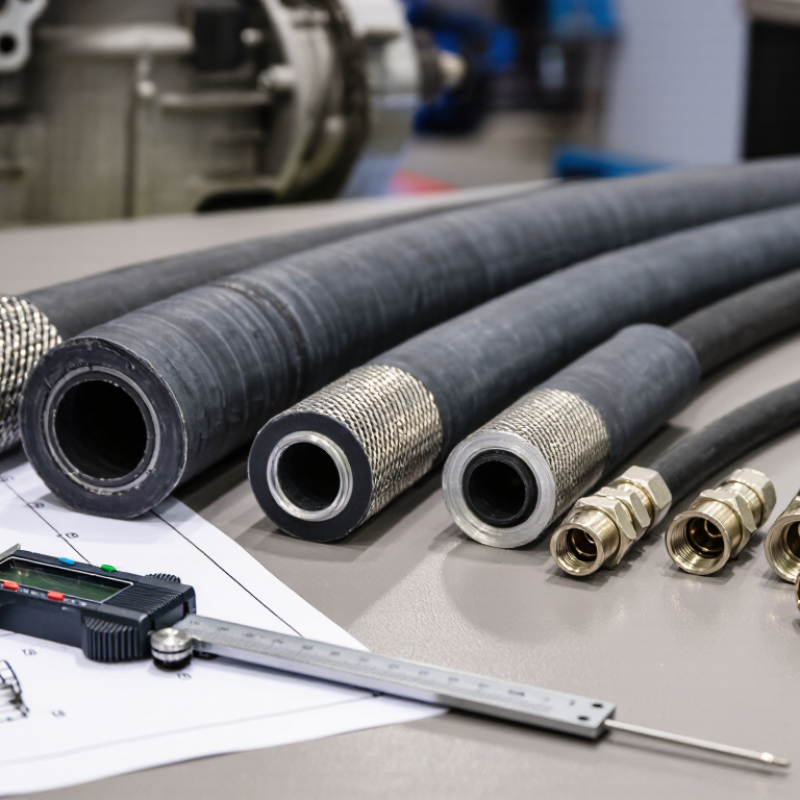
Reinforcement shapes how a hose handles pressure, movement, and vacuum. Textile braid can provide flexibility, while wire reinforcement may support higher pressure or resist collapse. The outer cover protects against abrasion, heat, and weathering. Look closely at the construction details. A hose routed around a tight bend can kink or fatigue, even when its pressure rating looks adequate on paper.

Reliable selection means matching the full assembly to actual service conditions. Check working pressure, temperature range, bend radius, and fitting compatibility together. Ask whether the hose has been tested for the intended fuel and duty cycle. A sample inspection can reveal uneven braiding, rough cut edges, or inconsistent wall thickness. It is tempting to specify the strongest option, but extra stiffness can make installation harder. That trade-off deserves a second look.

Top Fuel Rubber Hose Manufacturers for Global Buyers — How Materials and Construction Shape Hose Performance

What this means for hose selection: Higher ethanol content can increase material-compatibility demands. The hose liner, elastomer formulation, and reinforcement all affect performance, so confirm that a hose is rated for the intended fuel and application.

U.S. blend figures: E10 contains up to 10% ethanol, E15 up to 15%, and E85 typically 51–83% by volume; E0 contains no ethanol by designation. Source: U.S. Department of Energy, Alternative Fuels Data Center.

Which Standards and Tests Apply to Top Fuel Rubber Hoses

Fuel-hose approval depends on its intended service, not just its outer appearance. SAE J30 covers fuel and oil hose applications in road vehicles, while SAE J1527 addresses marine fuel systems. These standards define requirements by hose type; a test result is meaningful only when the specified class and current edition are identified.

Several recognized methods examine different failure risks. ISO 1817 measures changes in rubber properties after exposure to liquids, including mass, volume, and hardness. ISO 1402 describes hydrostatic pressure testing, while ISO 8033 measures adhesion between hose layers. ASTM D380 provides methods for testing rubber hose. Details matter. Ask for reports showing the test fluid, temperature, duration, pressure, sample construction, and acceptance limits—not merely a “passed” statement.

A credible supplier should connect each report to the hose’s intended fuel and operating conditions. Check whether the sample came from routine production or a specially prepared qualification batch. That distinction can be easy to miss. Reference-fluid results do not represent every fuel blend, temperature cycle, or years of field aging. One test cannot tell the whole story. Keep the standard edition and test conditions with purchasing records, and review them when the hose design or application changes.

How to Evaluate Top Fuel Rubber Hose Manufacturers

When evaluating fuel rubber hose manufacturers, look beyond catalog claims. Grand View Research’s Automotive Rubber Molded Components Market report estimates the broader market reached USD 47.83 billion in 2023, with a 6.1% forecast compound annual growth rate from 2024 to 2030. This covers more than fuel hoses, so it signals industry scale, not hose quality. Numbers need context.

Ask for test reports tied to the exact hose construction, not a similar product. Check fuel compatibility, working pressure, temperature range, permeation, and resistance to aging. SAE J30 provides relevant performance requirements for automotive fuel and oil hoses; request evidence showing which requirements were tested and under what conditions. Inspect sample cut ends, too. Even reinforcement layers and consistent wall thickness can reveal production control. A neat sample is not proof of a stable process.

Review batch traceability, material change records, and the supplier’s response to failed tests. Ask how long retained samples are kept and whether independent laboratory results are available. Compare stated service conditions with your actual fuel blend, engine-bay heat, and routing bends. A supplier may pass a laboratory test yet perform poorly in a cramped installation. That gap is easy to overlook. Audits can miss it, especially when paperwork is complete but test methods are unclear.

Top Fuel Rubber Hose Manufacturers for Global Buyers - How to Evaluate Top Fuel Rubber Hose Manufacturers

Use this buyer evaluation framework to compare suppliers against the requirements of your application. The suggested weights total 100 points; confirm every requirement against the current product specification and applicable market regulations.

Evaluation dimension Suggested weight What to evaluate Evidence to request or verify
Fuel and media compatibility 20 points Confirm compatibility with the actual fuel and any additives used, such as gasoline, diesel, or ethanol-containing blends. Check the complete hose construction, including the inner tube, reinforcement, and cover—not just the listed rubber type. A written compatibility statement for the exact hose construction and intended fuel; supporting test information and stated limitations, where available.
Applicable standards and intended use 20 points Check that the product is designed for the application, such as automotive fuel service, marine fuel service, or fuel dispensing. SAE J30 covers automotive fuel and oil hose specifications. ISO 7840 addresses fire-resistant fuel hoses for small craft, while ISO 8469 addresses non-fire-resistant fuel hoses for small craft. Standard number and edition, product classification, scope of certification or declaration, and documentation identifying the exact model covered. Do not treat different standards as interchangeable.
Pressure, temperature, and dimensions 15 points Match the rated working pressure, temperature range, inside diameter, outside diameter, bend requirements, and connection method to the installation. Distinguish working pressure from burst pressure. Current datasheet with units, rated limits, dimensional tolerances, and any restrictions for continuous, intermittent, or submerged service.
Testing and quality control 15 points Assess whether the supplier controls incoming materials and production, and tests relevant performance properties. Test selection should reflect the product specification and intended application. Quality-control plan, sample inspection or test reports, test methods, acceptance criteria, and records linking test results to the supplied product or production lot.
Traceability and documentation 10 points Check that hose markings, packaging, and records can identify the product and support traceability. Confirm that technical documents are consistent with the product actually offered. Sample hose marking, lot or batch identification method, certificate of conformity where applicable, and controlled versions of technical documents.
Certifications and regulatory fit 10 points Determine which approvals or declarations are required in the destination market and for the specific end use. Verify that any claimed approval applies to the exact product and intended installation. Current certificates or declarations, issuing body, validity dates, covered product references, and any conditions or exclusions.
Engineering support and customization 5 points Evaluate support for application questions, drawings, hose assemblies, packaging, and clearly defined custom requirements. Customization should not obscure the tested specification. Documented technical response process, product drawings or samples where relevant, and written confirmation of changes to materials or construction.
Supply and export readiness 5 points Review production capacity, lead-time communication, packaging for transport, and the supplier’s ability to provide export documents required for the transaction. Written quotation with product specification, quantity, lead time, packaging details, and agreed shipping and documentation terms.

How Global Buyers Can Compare Suppliers and Manage Sourcing

Global buyers should compare fuel hose manufacturers against one shared specification, not polished catalog claims.

List the fuel type, temperature range, working pressure, inner diameter, length, bend radius, and fitting requirements. Ask suppliers to explain their tube, reinforcement, and cover materials, then provide compatibility data for the intended service. Request test reports identifying the method, sample batch, and acceptance limits; a generic certificate proves little. Check traceability from raw material receipt to finished hose, including how production changes are recorded. Small details matter.

Before placing a large order, test production samples for dimensions, flexibility, leakage, and fit with the actual assembly. Where service conditions warrant it, review aging or impulse-test results rather than relying on one burst figure. Compare quotations beyond unit price: minimum order quantity, tooling charges, packaging, shipping route, lead time, and spare capacity all affect supply risk. Ask how suppliers handle rejected batches and corrective actions, and agree on inspection records before shipment. Real supply chains vary. Build a modest buffer for critical sizes, then revisit it when demand or transit times shift. Even a sound audit has limits; verify performance periodically, especially after material or process changes.

Back To Top