
Who Is a Top Inflatable Santa Claus Manufacturer in China?

Finding a top Inflatable Santa Claus manufacturer in China takes more than comparing catalog photos or low quotations. Buyers should look for clear product specifications, consistent workmanship, and answers that address real use conditions. A cheerful Santa may look impressive online, yet small details matter: reinforced seams, even printing, secure tie-down points, and a blower sized for the decoration. Ask whether the factory can explain its materials and production checks in plain language. Specific answers are more useful than broad promises.

Good evidence helps separate reliable suppliers from attractive listings. Request recent product photos, a sample, or a video showing inflation and deflation. Check how the unit stands on a flat surface and whether its cords, stakes, and instructions are included. For larger orders, ask about sample approval, packaging dimensions, lead times, and how defects are handled. These steps do not guarantee a perfect result. They make expectations clearer.

Experience also means noticing what a catalog cannot show. A sample can reveal fabric feel, seam quality, and how colors appear under ordinary lighting. Still, no checklist catches everything. A supplier may communicate well but struggle with a rushed schedule, so confirm key details in writing and allow time for review. This guide explores practical ways to assess Chinese manufacturers, compare offers fairly, and identify a partner suited to your quantity, design, and delivery needs. The best choice is not automatically the cheapest or most famous. It is the supplier whose claims can be checked and whose product fits the job.
Who Is a Top Inflatable Santa Claus Manufacturer in China?

What Defines a Top Inflatable Santa Claus Manufacturer in China?

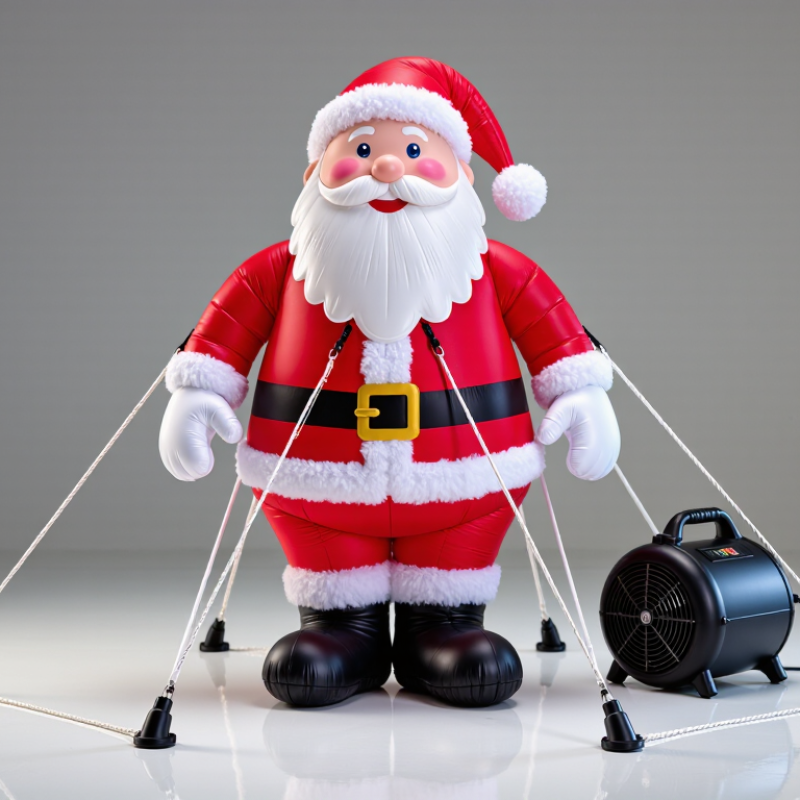
A top inflatable Santa manufacturer is defined less by festive graphics than by repeatable engineering. Ask for fabric specifications, seam construction, blower airflow, and stated weather limits. A 2.4-meter figure should stand evenly, with anchor loops placed where gusts pull hardest. Good samples show sealed seams, balanced lighting, and access zippers that do not snag. Details matter. Factories should record prototype revisions and inspect production units, not just approve one sample. That evidence makes quality claims traceable.

Material and electrical choices also reveal competence. The U.S. Department of Energy’s Energy Saver guidance reports that LEDs use at least 75% less energy than incandescent lighting. It also says LEDs can last up to 25 times longer. For an illuminated Santa, manufacturers should specify LED ratings, adapter output, and replaceable parts. Ask for inspection records, packaging test results, and clear anchoring and drying instructions. Test it outdoors. No supplier is flawless; even a capable factory can miss a stitch or misjudge a blower. A reliable one documents defects, corrects causes, and gives realistic lead times before orders are placed.

Which Specs Matter: Santa Height, Fabric Denier, Blower Wattage, and IP Rating?

A dependable inflatable Santa is chosen by matching its dimensions and materials to the installation site. Measure the available height, including clearance beneath roofs and branches. A 2.4-meter figure can look impressive outdoors but overwhelm a small porch. Fabric denier measures yarn mass: one denier equals one gram per 9,000 meters. Higher denier alone does not guarantee stronger fabric; weave, coating, and seam construction matter too. Ask for sample panels and inspect stitched corners. That detail is easy to overlook.

Blower wattage indicates electrical input, not inflation strength by itself. Request airflow data as well, and compare wattage with the figure’s size and shape. The U.S. Department of Energy’s energy-use guidance calculates consumption from watts and operating hours: a 100-watt blower running ten hours uses 1 kilowatt-hour. For outdoor placement, check the complete unit’s IP rating, not just the blower. IEC 60529 defines the rating system; IP44, for example, indicates protection from objects over 1 millimeter and water splashes from any direction. It does not mean protection from every storm. Ask for test documentation, seams checked after inflation, and operating guidance. I would still test a sample outdoors; specification sheets can miss small leaks.

Who Is a Top Inflatable Santa Claus Manufacturer in China?

Compare the specifications that matter when evaluating an inflatable Santa: height, fabric, blower wattage, and IP rating.

The chart shows representative retail height options, not a manufacturer ranking; availability varies by model. For a useful comparison, confirm the fabric construction (for example, 190T polyester or 210D Oxford—“T” and “D” are different specifications), the blower’s rated wattage, and the exact IP rating on its label. An IP rating for the blower does not establish that the entire decoration is weatherproof.

How Does IEC 60529 IP44 Protect Against Objects over 1 mm and Water Splashes?

IEC 60529 IP44 describes two separate protections. The first “4” means the enclosure resists solid objects 1 mm across or larger. It helps keep small tools, wires, and similar objects from reaching hazardous parts. That matters outdoors.

The second “4” indicates protection against water splashing from any direction under specified test conditions. It is not a promise of protection from immersion, strong water jets, or every kind of heavy rain. Not waterproof. For an inflatable Santa, check which components carry the rating: an electrical enclosure may be IP44 while seams, cables, or the blower are not. Water can still find an unprotected opening.

When comparing manufacturers in China, ask for test documentation identifying the exact product and rated components. Check that the rating applies to the supplied configuration, not just a separate enclosure. Also inspect cable entry points, plugs, and instructions for outdoor placement. A visible IP44 label is useful, but it cannot replace correct setup or care. I would be cautious about treating one rating as proof that the entire decoration is weatherproof.

Who Is a Top Inflatable Santa Claus Manufacturer in China? - How Does IEC 60529 IP44 Protect Against Objects over 1 mm and Water Splashes?

Evaluation Area Data Point Meaning or Practical Detail What to Check
Manufacturer selection Product specifications Inflatable Santa products can differ in height, fabric, lighting, blower arrangement, and intended use. There is no single specification that identifies a “top” manufacturer. Request a written specification for the exact model, including dimensions, materials, included accessories, and operating requirements.
Manufacturer selection Outdoor-use evidence An outdoor-use claim should be supported by details about the product’s electrical components and installation instructions; it should not be inferred from appearance alone. Check the labels and documentation for the blower, lights, connectors, and any required weather protection.
Manufacturer selection Quality and compliance records Product tests and certificates apply to the product or component and scope stated in the documents. A certificate for one component does not automatically cover the complete inflatable display. Match document model numbers and test scope to the supplied product. Confirm applicable requirements for the destination market.
IEC 60529 ingress protection IP code structure In “IP44,” the first “4” describes protection against solid objects; the second “4” describes protection against water. Look for an IP rating on the relevant equipment and verify which parts of the assembly it covers.
IEC 60529: solid objects First digit: 4 IP4X protection is tested against access by solid foreign objects 1.0 mm in diameter and larger. It is not a dust-tight rating. Confirm that the rating applies to the specific enclosure or electrical component, rather than assuming it applies to the entire decoration.
IEC 60529: water Second digit: 4 IPX4 indicates protection against splashing water from any direction under the specified test conditions, with no harmful effect as defined by the standard. Check the test report or product documentation for the tested model and component.
IP44 limitations Not a jet or immersion rating IP44 does not claim protection against water jets or submersion. It also does not establish that fabric, seams, or every electrical connection in an inflatable is weatherproof. Follow the manufacturer’s placement, connection, and weather-use instructions; keep unprotected connections out of wet conditions.
Installation and use Blower and electrical connections The blower generally needs an unobstructed air intake, and outdoor electrical connections may need protection appropriate to their exposure and local electrical rules. Use the specified blower and accessories, secure the inflatable as instructed, and inspect cables and connectors before use.

How Do ISO 9001 and ISO 2859-1 AQL Sampling Verify Factory Quality?

For buyers assessing a top inflatable Santa Claus manufacturer in China, quality claims need evidence. ISO 9001 provides a framework for documented processes, inspection records, corrective actions, and supplier controls. The ISO Survey 2022 recorded 1,265,216 valid ISO 9001 certificates worldwide. Certification signals a managed quality system, not flawless products. Ask to see the factory’s current certificate scope and recent inspection records.

ISO 2859-1 uses attribute sampling to inspect a production lot. The sample size depends on lot size, inspection level, and the selected AQL; AQL is not a promise that every unit will meet that percentage. Inspectors might check fabric seams, welded panels, print alignment, blower operation, and air leakage. A practical report should identify the lot, sample size, defects found, and acceptance decision. Keep the record.

During a factory audit, compare the written procedure with the actual workbench. Are rejected units tagged? Can staff trace a sampled Santa to its batch? Small gaps matter. AQL sampling reduces inspection effort, but it cannot reveal every defect, especially inconsistent problems. Combining documented ISO 9001 controls with a clearly defined ISO 2859-1 sampling plan gives buyers stronger, verifiable evidence than a certificate alone.

Which MOQ, Lead-Time, and Warranty Metrics Help Compare Chinese Suppliers?

For inflatable Santa Claus suppliers, MOQ should be checked by size, fabric, print, and electrical configuration—not just by total units. Ask whether a mixed-size order counts toward one MOQ, and request separate prices for samples and production. A low MOQ can help test demand, but may raise unit costs. Check the sample for seam strength, fan fit, and printed color before approving bulk production. Small details matter.

Compare lead times as separate stages: sample approval, material sourcing, production, inspection, and dispatch. Request calendar days, the order-start trigger, and a written delay update schedule. UNCTAD’s Review of Maritime Transport 2024 reported Shanghai–Europe container spot rates rising from about $1,200 per 40-foot unit in December 2023 to nearly $4,800 in June 2024. That is freight pricing, not factory lead time, but it shows why shipment buffers matter. A spreadsheet still misses the busy-season rush.

Warranty terms should name the coverage period and remedy for defective seams, motors, or lights. Ask who pays return freight and whether photo or video evidence is accepted. Request the supplier’s defect-rate records and inspection checklist; compare the same production period across quotations. Test one sample through repeated inflation and deflation. It is not a perfect substitute for field use, but it exposes weak stitching and loose fittings early.

Back To Top