Top 10 Parallel Spunlace Nonwoven Fabric Manufacturers
Parallel Spunlace Nonwoven Fabric combines a predominantly aligned fiber web with water-jet entanglement. The result can offer a smooth surface, useful strength, and flexibility across many applications. These characteristics make it relevant to wipes, hygiene products, medical materials, and selected industrial uses. Performance still depends on fiber type, basis weight, finishing, and the intended end use.
Choosing a manufacturer takes more than comparing catalog descriptions. Buyers should examine production capabilities, quality-control practices, customization options, lead times, and technical support. Ask for current product data and samples, then assess absorbency, linting, tensile behavior, and consistency against your own requirements. Details matter.
This overview of ten Parallel Spunlace Nonwoven Fabric manufacturers is intended to help readers begin that assessment. It highlights factors that can distinguish suppliers, while recognizing that capabilities and product ranges may change. A company’s stated capacity does not automatically guarantee a match for every specification. No supplier fits every need. Some information may also be difficult to compare across manufacturers, so confirm important claims directly before making a purchasing decision. The best choice is the one that can reliably meet your product requirements, communicate clearly, and support repeatable quality—not simply the one with the broadest claims.
What Parallel Spunlace Nonwoven Fabric Is
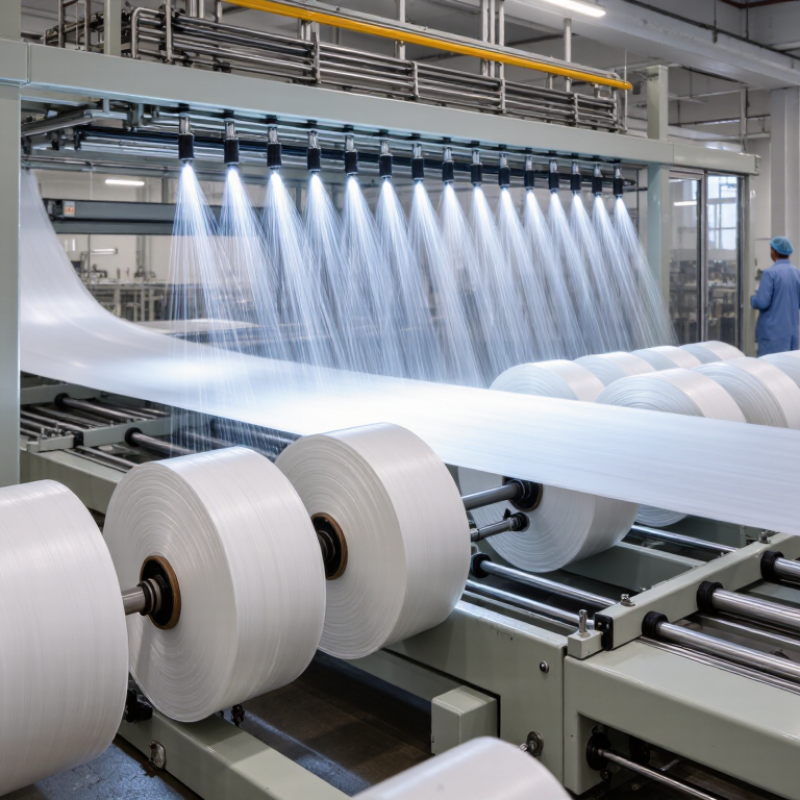
Parallel spunlace nonwoven fabric begins as a loose web of fibers laid mainly in one direction. This arrangement is called parallel laying. Fine water jets then push the fibers through and around one another, forming a coherent sheet without weaving or knitting. No stitching is involved. The web’s direction matters: tensile strength may be higher along the machine direction than across it. The exact difference depends on fiber type, web weight, and production settings.
The fabric can feel soft, flexible, and cloth-like, but those qualities are not guaranteed by the name alone. Fiber blends and finishing treatments change the hand, absorbency, and durability. Some products use viscose or polyester; others combine fibers to balance strength and liquid uptake. In use, parallel spunlace appears in wipes, hygiene products, filtration media, and selected medical or automotive materials. Not every grade suits every task. A wipe that absorbs quickly may not hold up well under repeated rubbing. The word “parallel” can sound more precise than production really is, since fibers still vary in placement across a moving web. Checking the material specification and testing a sample are sensible steps.
How to Evaluate Parallel Spunlace Fabric Manufacturers
When evaluating parallel spunlace fabric manufacturers, ask for data from production lots, not only a carefully selected sample. Parallel-laid webs can behave differently in the machine and cross directions. Compare basis weight, tensile strength, elongation, absorbency, and lint across both directions. ISO 9073-3 provides a method for measuring tensile strength and elongation in nonwovens. Ask whether test conditions match your intended use. A polished sample can mislead.
Capacity matters, but repeatability matters more. Request recent lot records, allowable basis-weight variation, production width, lead time, and details on fiber composition and hydroentanglement controls. The Grand View Research Nonwoven Fabric Market report estimated the global market at USD 53.9 billion in 2022, with a projected 5.8% annual growth rate from 2023 to 2030. That broad market figure is not specific to spunlace, but it signals why supplier claims deserve careful checking. Ask for a trial roll and inspect it after converting or wet use. I would still question any supplier that cannot explain test methods clearly. Small gaps in documentation can become real production problems.
Profiles of the Top 10 Parallel Spunlace Nonwoven Fabric Manufacturers
Parallel spunlace fabric relies on evenly distributed fibers, followed by high-pressure water jets that bond the web. Manufacturer comparisons should examine basis-weight consistency, tensile strength, line width, and fiber blend control.
EDANA reported European nonwoven production of about 2.94 million tonnes in 2023, a useful sector-wide benchmark—not a spunlace-only figure.
The ten profiles below describe capabilities, not an audited ranking.
One profile represents high-volume producers focused on stable commodity rolls. Another specializes in viscose-polyester blends for soft, absorbent wipes. A third develops pulp-fiber blends, where fiber dispersion can be difficult to maintain. A fourth emphasizes controlled production for hygiene applications; buyers should verify the relevant product specifications. The fifth focuses on household wipes, often tuning softness and liquid uptake.
The remaining profiles include wide-web lines for bedding and interiors, lightweight fabric specialists for cosmetic pads, and producers testing recycled fibers. Recycled content can introduce variability. Custom-run manufacturers serve buyers needing short lots and specific finishes, while integrated producers pair fabrication with in-house testing. Useful checks include roll-edge uniformity, lint levels, and sample performance after wet handling. A sales claim alone is not evidence.
Industries and Applications Served by Leading Manufacturers
Parallel spunlace nonwoven fabric serves industries that need a balance of softness, strength, and reliable converting. In this process, water jets entangle fibers, while parallel web formation gives the fabric a stronger machine-direction orientation. That structure can suit products pulled or fed through production lines. Details matter.
Wipe manufacturers use these fabrics for household, personal-care, and industrial cleaning products. They may specify absorbency, low lint, sheet thickness, and wet strength. A workshop wipe faces oil and repeated handling; a facial wipe needs a gentler feel. One fabric cannot meet every brief. Converters often test samples with the actual lotion, cleaning fluid, or packaging method before choosing a grade.
Hygiene and medical-product suppliers may use spunlace in disposable towels, gowns, or dressing components, depending on the required specification. The fabric itself does not guarantee sterility or clinical performance. Automotive and home-furnishing producers also use it in interior liners, backing layers, and cushioning components, where consistent width and tensile behavior support assembly. Filtration applications can require tighter control of fiber blend and pore structure. Buyers should check technical data and run application-specific trials; a detail like edge fraying may only appear after cutting. That is easy to overlook.