How to Use PET Tape for Journals?
Journals turn everyday notes into personal records, and a strip of PET Tape can add color, texture, or a clear protective layer. PET means polyethylene terephthalate, a durable film used in many decorative tapes. It can work well over handwritten headings, photo corners, and small paper collages. But tape performance varies. Adhesive strength, finish, and removability depend on the product and the page.
Industry reports offer useful context, though they do not measure journal-tape use specifically. Grand View Research estimated the global stationery products market at USD 128.4 billion in 2023 and projected a 4.3% compound annual growth rate from 2024 to 2030. Smithers’ The Future of Global Print to 2028 provides broader insight into printed products and changing print applications. These figures describe large markets, not a guarantee that every tape suits every journal. Small details matter.
This guide explains how to choose PET Tape For Journals, cut it cleanly, and place it without hiding important writing. You will also learn simple ways to layer transparent designs, avoid trapped air, and test adhesion on an inconspicuous page. Test it first. Paper coatings can react differently, and “removable” does not always mean residue-free. A small trial may feel fussy, but it can save a favorite page.
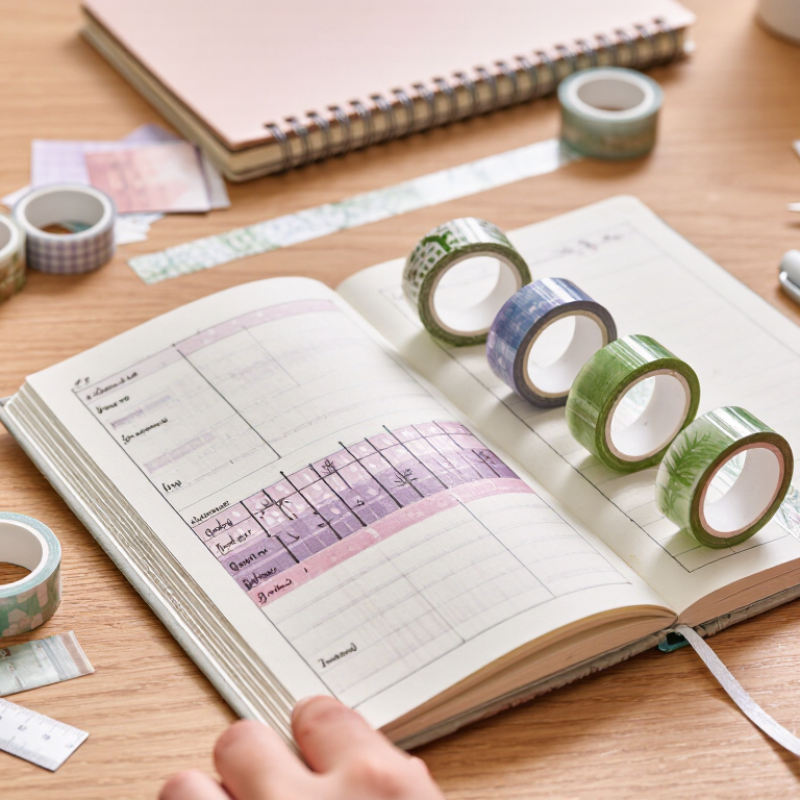
Understanding PET Tape and Its Uses in Journaling
PET tape is a thin polyester film with an adhesive side. In journaling, it can add shiny borders, transparent overlays, or small printed details. Its smooth surface often feels sturdier than paper tape, and light can catch its glossy finish. Some designs are clear; others have opaque colors or foil-like accents. Check the backing before cutting, since certain tapes are easier to handle when kept on their liner.
Tips: Test a small piece on a spare page. Press gently from the center outward to reduce bubbles. If the tape overlaps handwriting, check that the text remains readable. Avoid assuming every PET tape peels off cleanly; paper quality and adhesive strength vary.
For a neat layout, trim a short strip with scissors and align it against a page edge. Curved shapes may need several small pieces rather than one long strip. A ruler helps with straight borders, though tiny misalignments can still happen. That is not always a flaw. A slightly uneven edge can make a spread feel handmade, but it may bother you later if you prefer precise grids. Store unused tape away from dust, which can cling to its adhesive.
Choosing the Right PET Tape for Your Journal
Choosing PET tape for a journal starts with the page itself. Thin, smooth paper can show adhesive marks or wrinkles more easily than sturdy cardstock. Check the tape’s width against your layout: narrow strips suit captions and borders, while wider pieces cover larger areas quickly. That matters. A clear tape can preserve handwritten details beneath it, but glare may make those details harder to read.
Look at the finish and adhesive description before buying. Matte surfaces tend to blend into paper; glossy ones catch light and make colors appear stronger. If the tape is meant to be repositionable, test it anyway. Press a short piece onto a spare page, leave it for a day, then peel it back slowly. Watch for lifted fibers, residue, or ink transfer. Paper varies, and “removable” does not guarantee a clean lift on every journal stock.
Consider how you plan to use the tape. For layered collages, a thinner film can sit flatter and reduce bulky edges. For frequent handling, a stronger bond may hold better, though it can be harder to adjust later. I find it tempting to choose by pattern alone; that choice can look lovely in a roll and feel too busy across a page. A small sample helps you judge color, transparency, and scale before committing.
Preparing Pages and Tools for Application
Before applying PET tape, let the journal pages lie flat on a clean, dry table. Brush away crumbs and paper dust with a soft, dry cloth; oils from fingers can interfere with adhesive contact. Check the tape on a small, hidden area first, especially on thin or coated paper. Keep scissors, a ruler, tweezers, and a clean scrap sheet nearby. The scrap sheet catches stray adhesive and helps you position short strips without touching their sticky edges. Keep it simple. NEDCC preservation guidance gives 30–50% relative humidity as a practical range for paper collections. That’s a storage guideline, not a strict tape-application requirement, but stable room conditions help avoid handling damp or unusually brittle pages.
Measure each strip before cutting, and leave a little space near the binding so pages can turn freely. Lay the tape down gradually, smoothing from the center outward with a clean fingertip or a soft applicator. Avoid stretching it; tension can lift edges later. ASTM D3330/D3330M describes a standardized 180-degree peel test for pressure-sensitive tapes. Its controlled method is a useful reminder that adhesion varies with the surface and test conditions, so no single figure guarantees performance in a journal. I still sometimes cut strips too long. A test piece on scrap paper is slower, but it can prevent a messy correction on the page.
Applying PET Tape Neatly to Journal Pages
PET tape can add crisp borders, labels, or small accents without hiding the paper beneath. Before applying it, make sure the journal page is clean and dry. Dust or hand cream can weaken the tape’s grip. Test a short piece on a similar scrap of paper, especially if the page is thin or coated.
For a straight edge, line up the tape with the page margin before pressing it down. Hold the loose end lightly, then smooth the tape from one side to the other with a fingertip or soft cloth. This helps reduce bubbles and wrinkles. Go slowly. If the tape has a release liner, peel it away in small sections rather than all at once. Avoid pulling the tape tight; stretched tape may curl or lift later. Trim the end with scissors for a clean finish, leaving a narrow margin if the journal’s edge bends easily. I still find that a tiny misalignment can bother me more than it should. Lifting and repositioning may damage delicate paper, so pause and check the placement before pressing firmly.
Layering and Preserving PET Tape Decorations
PET tape works well in a journal because its clear film lets colors and handwriting show through. Before layering, wipe the page with a dry cloth and test a small piece near the back of the journal. Some papers have a slick coating, so the adhesive may not hold evenly.
Place the widest piece first, then add narrower strips across it or at a slight angle. Press from the center outward with a fingertip or soft cloth to limit trapped air. Leave a slim gap between patterns if the page starts to look crowded. Less is enough. I sometimes add one strip too many, and the page feels busier than I intended.
For a flatter finish, trim the tape with small scissors rather than tearing it. Keep adhesive edges away from the journal’s fold, where repeated opening can lift them. Let it rest. Store the journal closed and away from direct sunlight, heat, and damp places. These steps can help the decoration stay neat, though adhesives may change over time. Check older pages now and then, especially if tape overlaps photographs or delicate paper.